

As OT’s in non-traditional areas of practice, I think there is often a struggle with imposter syndrome and that haunting reputation of ambiguity in professional practice. We doubt ourselves so often, wondering if our practices are within scope, and feeling a little blurry about how they relate back to occupation. I’ve been a bit unclear recently about a few concepts as I’m coding the case study transcripts, and have been reflecting on how well do I feel I understand OT roots. I was surprised to find I didn’t feel as confident as I thought I should have. So, I’ve been going back to basics. I’ve gone to the annexes of the library and dug out a handful of texts that I felt I needed to brush up on.
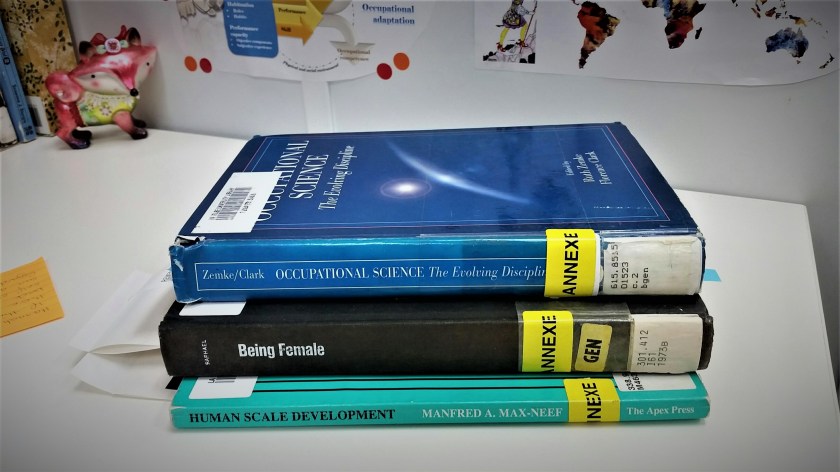
The book which has struck me most today is about occupational science.
Zemke, R., & Clark, F. (1996). Occupational science : The evolving discipline. Philadelphia: F.A. Davis.
When I attended and presented about my research at the COTEC-ENOTHE Congress in Ireland a few years ago, I was surprised about my research being categorised under ‘occupational science’. I received some significant feedback during that session from some leading European OT’s and who were very well versed in occupational science, which I found really challenging at the time. They recommended strongly to me that I should familiarise myself with occupational science as a priority. I must confess it’s been on the backburner a bit since then, but I’ve just reached a point with my research now that the knowledge gap is starting to impact on the quality of my work.
As an OT, I often struggle to accept the relevance of occupational science to OT practice. I wonder if this is similar for OT’s practicing in other parts of the world? I’ve been reading this primary occupational science text, and keeping my mind as open as possible. I’ve decided to embrace the challenge, and really learn about how we fit together, and why occupational science is so relevant to perinatal OT practice.
Did you know one of the primary reasons occupational science exists is to help the OT profession grow and evolve into the 21st Century? Until a few months ago, I didn’t.
Part of the reason occupational science was developed was to offer a “framework for understanding the relationship of biology to meaning”, and that “if occupational science and occupational therapy are truly integrated, new clinical approaches may emerge that … suggest some new or expanded directions for practice”, which “can be used to improve patient care” (Zemke & Clarke, 1996, p. 325). What more could we ask for?!
The clues about the relevance and pertinence of occupational science for perinatal maternal health have rolled out in droves as I’ve read many chapters, but especially in these sections:
- Section V: Co-occupations of mothers and children, pp. 213-216.
- Chapter 21: Games mothers play with their full-term and pre-term infants, pp. 217-226.
- Chapter 23: A Phenomenology of motherhood, pp. 243-246.
I have quickly found many favourite quotes from this textbook, but I think today this one is striking a chord:
“There are two kinds of visionaries: those who go after the holy grail without caring who they stomp on in the process because their eye is on some specific future goal, and those I call peripheral visionaries who work on the tasks of today and tomorrow with their eyes open, with a breadth of attention and vision that is inclusive and holistic. Occupational scientists and occupational therapists are called to be the second kind of visionaries, to bring the breadth of their attention and an inclusive holistic vision to bear on occupation in human life and in health” (Zemke & Clark, 1996, p12).
Should OT’s should not feel the need to justify why their role is different because they are constantly concerned that they are encroaching on other professional disciplines scope of practice? No. I don’t think so.
As OT’s, I think we should be more confident to clearly articulate what we’re doing from an occupational perspective, with confidence that our practice is important in its own right. We are unique, we are highly skilled, and we are capable of offering holistic client-centered services that are tailored for unique populations who are experiencing challenges with occupation, occupational change and co-occupational adaptation. I hope this is how occupational science can help inform and strengthen the integrity, future and growth for perinatal occupational therapy. We just need to spend time learning to understand how.

 Research & evidence-based practice for OTs in perinatal health, motherhood, and matrescence