

Becoming a mother is known to be a significant life event for women. It means different things to different women in different communities and cultures, in a kaleidoscope of ways. An increasing number of occupational therapists around the world are working to support women’s unique and individual issues and needs as they become mothers. They identify occupational performance issues women experience during these life transitions, and ways to support women according to client-centered and evidence-based practice principles.
Recently I’ve been preoccupied with wondering about our professional vocabulary. In the same way we’ve been debating the appropriateness of the term “occupation” to describe what type of therapy we provide, I wonder if we should redirect some of that curious energy to question the words we use to understand maternal health? What influence does the language we use to interpret and understand the role of occupational therapy in supporting women during the transition to mother? How does the terminology we use influence our clinical practice decisions? Are we limiting our professional knowledge acquisition by feeling obligated and bound to using medical definitions of maternal healthcare models and systems?
How do the words we use and choose shape our understanding of the OT role in women’s maternal health?
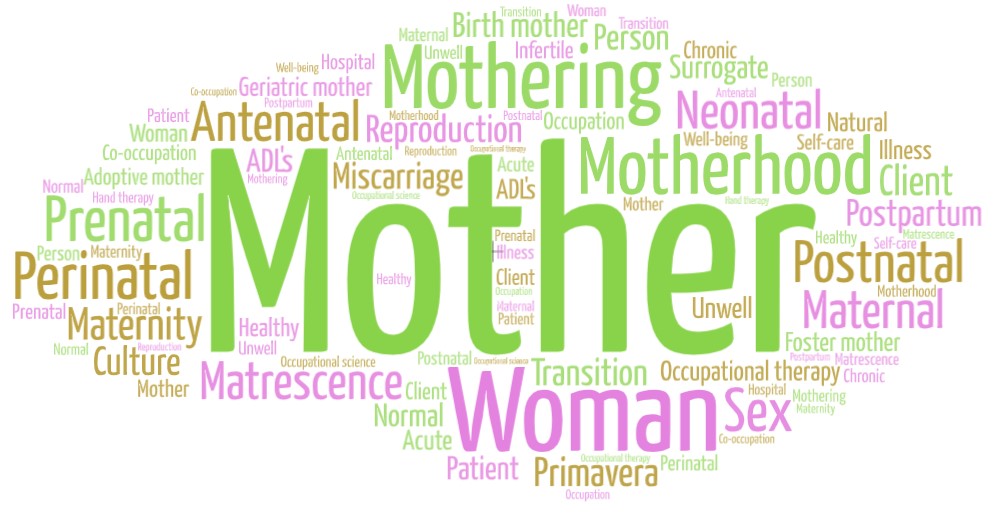
Occupational therapists work with women during so many stages of their journeys to and through motherhood. For me, the more I learn about ‘matrescence’, the more I feel clear about it’s relevance to the occupational therapy role in women’s health during motherhood transitions. I’m still learning – there’s a lot to learn! – but I want to share moments of my knowledge journey in discovering this term, including how it changes my thoughts and perspectives on both women in the context of becoming a mother, and the occupational therapists who support them. I hope that sprinkling little ‘new’ knowledge kernels might help occupational therapists to perpetuate their curiosity and question their understanding, familiarity and confidence in using and applying a professional vocabulary which is true and authentic to their practice.
Let’s start with the basics and tackle things bit by bit… Here’s my current interpretation of some key terms I’ve noticed occupational therapists are using to describe their practice and clients, and some I use when I’m listening to their stories:
Motherhood: A life phase/chapter of being a mother
Mothering: The duties and tasks of mothering occupations
Mother: A person who identifies themselves as such
Perinatal: There are a handful of definitions for this term, which describes a period from late pregnancy through to early postpartum. This term was originally developed for using medical maternal health and obstetrics, and includes prenatal, antenatal, labour, birth, postpartum and postnatal (the three trimesters, [arguably four: https://jordaninstituteforfamilies.org/collaborate/community-initiatives/4thtrimesterproject/]).
From what I’ve heard and learned along the way, I am currently considering that ‘perinatal’ is part of matrescence. I wonder; How much has our respect for and value of medical terminology biased how we understand women’s health and wellbeing when becoming mothers? Are we allowed to look outside the obstetric and medical definitions of maternal health and perinatal status to better understand how occupational therapists interpret and address women’s issues and needs? Yes. I think we can.
Matrescence: Refers to the developmental transition of becoming of mother (likened to the term ‘adolescence’, for becoming an adult). Originally developed and used exclusively by anthropologists. In the last 10-15 years is being revived and refreshed by sociologists and psychologists to interpret women’s maternal health and mothering in contemporary societies.
“The process of becoming a mother, coined by Dana Raphael, Ph.D. (1973), is a developmental passage where a woman transitions through pre-conception, pregnancy and birth, surrogacy or adoption, to the postnatal period and beyond. The exact length of matrescence is individual, recurs with each child, and may arguably last a lifetime! The scope of the changes encompass multiple domains –bio-psycho-social-political-spiritual– and can be likened to the developmental push of adolescence”, Aurélie Athan, Ph.D.
“An experience of dis-orientation and re-orientation . . . in multiple domains: physical (changes in body, hormonal fluctuations); psychological (e.g., identity, personality, defensive structure, self-esteem); social (e.g., re-evaluation of friendships, forgiveness of loved ones, gains in social status, or loss of professional status), and spiritual (e.g., existential questioning, re-commitment to faith, increased religious/spiritual practices)” (Athan & Reel, 2015, p. 9).
I’m going to leave this post hanging without drawing any major conclusions. I hope that by doing this there might be cause to wonder what should be written next.
What do you think? Does this resonate with occupational therapy conceptual philosophies as you understand them?
Sleeves are rolled up, and more blog posts are coming…
References, and links for the curious:
Aurélie Athan, Ph.D. – Webpage: https://www.matrescence.com/
Athan, A., & Reel, H. L. (2015). Maternal psychology: Reflections on the 20th anniversary of Deconstructing Developmental Psychology. Feminism & Psychology, 25(3), 311-325. https://doi.org/10.1177/0959353514562804
Book – Raphael, D. (1975). Matrescence, Becoming a Mother, A “New/Old” Rite de Passage. In D. Raphael (Ed.), Being Female: Reproduction, Power, and Change (pp. 65-72). Mouton Publishers.

 Research & evidence-based practice for OTs in perinatal health, motherhood, and matrescence