
The perinatal rites of transition within matrescence: Finding a common framework and language for OTs in maternity care

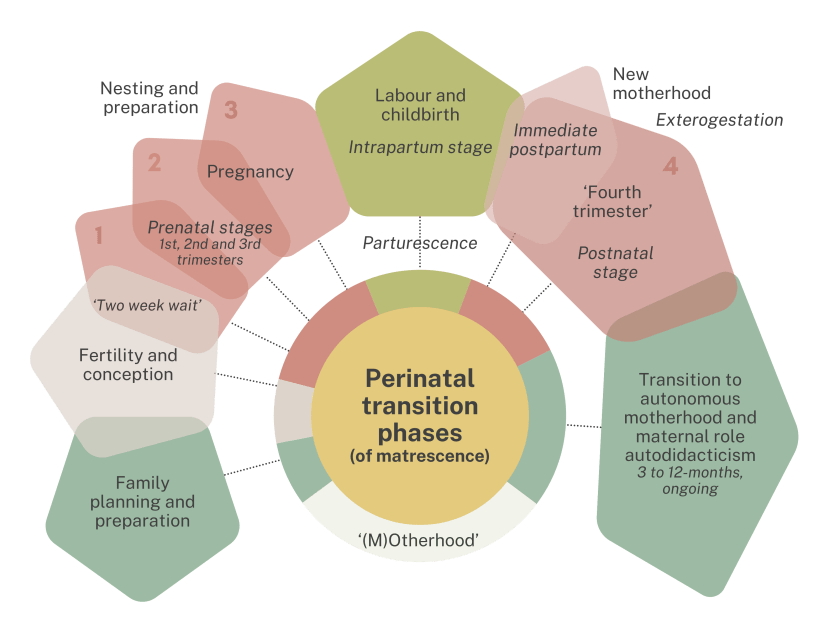
Reprinted with permission: Figure 10.1 A rite of transition: The chronological pathways, milestones, stages, and phases of perinatal transitions, from p. 255 of Slootjes, H. (2025). The perinatal transitions of matrescence: An occupational therapy perspective. In H. Slootjes (Ed.), Enhancing women’s wellbeing during matrescence, motherhood, and perinatal transitions: An evidence-based guide for occupational therapists (pp. 237–260). Routledge. https://doi.org/10.4324/9781003397724-12.

Again, it’s a bit different…

I’m writing this blog post again with a bit of a different lens. It’s following on from the previous post about the occupational nature of matrescence – taking a lifespan perspective – shifting our focus to understand how we contextualise our practices supporting mothers and birthing people during perinatal transitions.

I’m feeling motivated to do this after getting some feedback this week that textbooks are intimating for a lot of people – and that the knowledge translation goal for me is super important. This one ended up being be a bit of longer post – which I hope isn’t a deterrent! Anyway, here goes… 🙂

So, again, we know the perinatal period is often treated as a short, clinical window of time, bracketed by birth statistics and developmental outcomes, and postnatal checklists. I want to make it clear that I’m not dismissing the importance of these – medical advancements have absolutely revolutionised options and outcomes associated with fertility and birth in many incredible ways – and I, for one, certainly wouldn’t be alive without them! Of course they’re not perfect, and – irrespective of funding – women within these systems definitely have needs which could be better met with full MDT input, including OTs.

Internationally, OTs are practicing with clients during the perinatal period, and we’re bringing our own unique lens to understanding needs and challenges during this transitional phase (my PhD research are findings represented by illustrative interpretation in Figure 17).

Reflecting on feedback I received about the Person-centred Occupational Model of Matrescence (POMM) (see Figure 17 from my PhD thesis below) – which mapped how occupational therapists can support women and families through these transformative phases by recognising the ecological, cultural, and deeply human dimensions of mother-becoming – it seemed important to really break down what this meant for OTs who were working with mothers during perinatal transitions.

Reprinted Figure 17: Proposed model of conceptual practice: The Person-centered Occupational Model of Matrescence (POMM), from p. 306 in Slootjes, H. (2022). The Role of Occupational Therapists in Perinatal Health [Doctoral thesis, La Trobe University]. Open Access at La Trobe (OPAL). https://doi.org/10.26181/19836172.v1.

After completing my PhD, I was lucky and privileged enough to have the space and opportunity to explore this further in a textbook chapter, The Perinatal Transitions of Matrescence: An Occupational Therapy Perspective (Slootjes, 2025). When we zoom out through a person-centred occupational lens, the perinatal period looks a bit different. From this perspective, the perinatal period is not a single event but a fluid series of transitions nested within the larger journey of matrescence (the ongoing, lifelong process of becoming [or not becoming, or even letting go of being] a mother).

Seeing the perinatal period as rite of transition, not timeline

While the POMM doesn’t feature much in the textbook, Figure 10.1 A rite of transition: The chronological pathways, milestones, stages, and phases of perinatal transitions – continues developing the idea that perinatal period is non-lineal and a continuum. This was developed to reflect what we see as OTs when we support someone through perinatal transitions, backed by evidence-based concepts in scientific literature.

It’s the lens that shapes our worldview for a certain time during matrescence (illustrated in Figure 17 of the POMM), and is characterised by so many occupational factors relating to loss, hope, fear, dread, gain, progress, and set-backs, expectations, circumstance, choice, recovery, healing and responsibility.

These can occur during any phase, from family planning and conception through pregnancy, labour, postpartum recovery, the early experiences of motherhood, and the period thereafter where mothering occupations shift to a more autodidactic phase. Each phase carries its own occupations, milestones, and rituals: nesting, preparing, birthing, healing, adjusting, learning, letting go.

This framing invites us to think less about rigid concepts of step-by-step “stages” and more about how individuals move through, circle back, or diverge from these transitions in their own time and way. Some pathways are linear, others are interrupted, cyclical, or nonlinear – either by choice or circumstances outside of control. Each tells a story about hope, fear, anticipation, resilience, identity, and adaptation.

Occupational therapy brings language to these lived experiences – recognising that having, doing, being, becoming, belonging, and interacting are central to how mothers navigate these phases (Slootjes, 2022). It’s a trick, really, because – as OTs – this kind of approach doesn’t fit neatly into existing maternity care services where there’s rarely funding for full allied health teams. But we do have a lot to offer the women who need our help. Many of us are responding by shifting into private practice to increase our availability for perinatal clients, and things will undoubtedly change as the evidence base for our services grows.


A rite of transition, not just a healthcare event

Across cultures, childbirth has always carried ritual significance – acts of protection, preparation, and communal care. In modern healthcare, many of these rituals have been replaced by routines: Discharge summaries, feeding schedules, medical follow-ups (Davis-Floyd, 2022). However, as Grimes (2000) reminded us, humans have a deep need to ritualise transformation.

Occupational therapists see rituals as meaningful occupations – the gestures that help women situate themselves within change. Lighting a candle before birth, crafting a nursery or nesting, giving gifts, writing a reflection after miscarriage, or sharing a baby’s “firsts” with community – each of these acts holds the power to integrate experience and identity.

When services make space for ritual and reflection, not just medical monitoring, the perinatal period becomes opportunity for supported rite of transition or a rite of passage – depending on the birthing person’s unique positionality and culture, and circumstances.


The five developmental domains in practice

During perinatal transitions, mothers experience changes across five developmental domains, all dynamically interacting within their ecological context:

  • Biological/physical: Transformation of the body’s systems and functions, affecting movement, sensation, energy, and participation.
  • Psychological: Emotional regulation, identity formation, neurobiological and cognitive shifts.
  • Social:/psychosocial Relationships, role negotiation, community expectations, and the occupational reorganisation of daily life.
  • Spiritual: meaning-making, belonging, and connection to something larger than oneself.
  • Political: the influence of policies, funding, safety, and social structures on how mothering is lived and valued.

From this view, perinatal care is not just about health, it’s about human development, wellbeing, quality of life, occupational adaption, and changing identities, roles, and routines, healthy relationships – and so much more.


When healthcare becomes holistic

The bioecological lens shared in the previous post about matrescence (Figure 7.1) helps us see how each mother’s experience is shaped by the systems surrounding her – the micro-level of family and co-parents, the meso-level of connected services and communities, the exo-level of workplace and policy environments, and the macro-level of cultural and ideological forces.

Occupational therapists can help bridge these levels, advocating for policies that protect perinatal wellbeing and designing services that honour women’s autonomy, rituals, and lived realities.

Imagine perinatal care that makes room for stories, spirituality, and agency alongside safety, science, and skill. That is what it means to move from “perinatal management” toward perinatal transition support. Things are definitely changing, and the OT workforce are gearing up and to get ready for the opportunities that are coming!


Questions we can ask ourselves as a reflection to guide future practice

  • What would it look like if we all treated the perinatal period as a rite of transition, rather than a clinical event?
  • How might we hold space for mother’s having positive experiences having, doing, being, becoming, belonging, and interacting during perinatal transitions, beyond focusing to ‘treat’ medical issues?
  • And how might we design care, education, and policy that reflect the full ecology of matrescence rather than just its medical margins?

Because the perinatal period does not define mother-becoming, and also is not the beginning or end of matrescence – it’s one incredible point of transition (and sometimes transformation) along the way. What do you think?


Key references
Davis-Floyd, R. (2022). Birth as an American rite of passage (3rd ed.). Routledge. https://doi.org/10.4324/978100300139

Grimes, R. L. (2000). Deeply into the bone: Re-inventing rites of passage. University of California Press.

Slootjes, H. (2022). The Role of Occupational Therapists in Perinatal Health [Doctoral thesis, La Trobe University]. Open Access at La Trobe (OPAL). https://doi.org/10.26181/19836172.v1.

Slootjes, H. (2025). The perinatal transitions of matrescence: An occupational therapy perspective. In H. Slootjes (Ed.), Enhancing women’s wellbeing during matrescence, motherhood, and perinatal transitions: An evidence-based guide for occupational therapists (pp. 247–274). Routledge. https://doi.org/10.4324/9781003397724-12
More than pregnancy, birth, and motherhood: Matrescence is a lifelong process

Over the past few years, I’ve watched and cheered as the term matrescence has started to gain traction in our collective conversations. We’re still in the early days, but it’s appearing in perinatal care, parenting spaces, academic literature, the press, and social media. More and more people are hearing it, using it, and trying to make sense of it. It’s exciting that a concept can be so important to so many people. We clearly need it.

But as matrescence gains popularity and visibility, I’ve noticed how quickly we’re trying to contain it. It seems the race is on to define it neatly, frame it clinically, and reduce it to something manageable. We’re doing what dominant Westernised, patriarchal, and colonising systems so often do: we’re shrinking a rich, human experience to make it more contained to make it comfortable, more marketable, and more palatable. We reducing matrescence to mean: pregnancy, birth, postpartum, and early motherhood.

Is this really what we want?

Language is incredibly powerful, and matrescence offers us a way out of that reduction. It gives to what so many mothers have long felt but struggled to articulate. It’s a profoundly human, mother-centred concept that validates the complexity of our identities, roles, and emotional landscapes during times of transition – and transformation. So, I’m writing this post as an open invitation to slow down and take a proper pause to reflect on how matrescence is being shaped by our society.

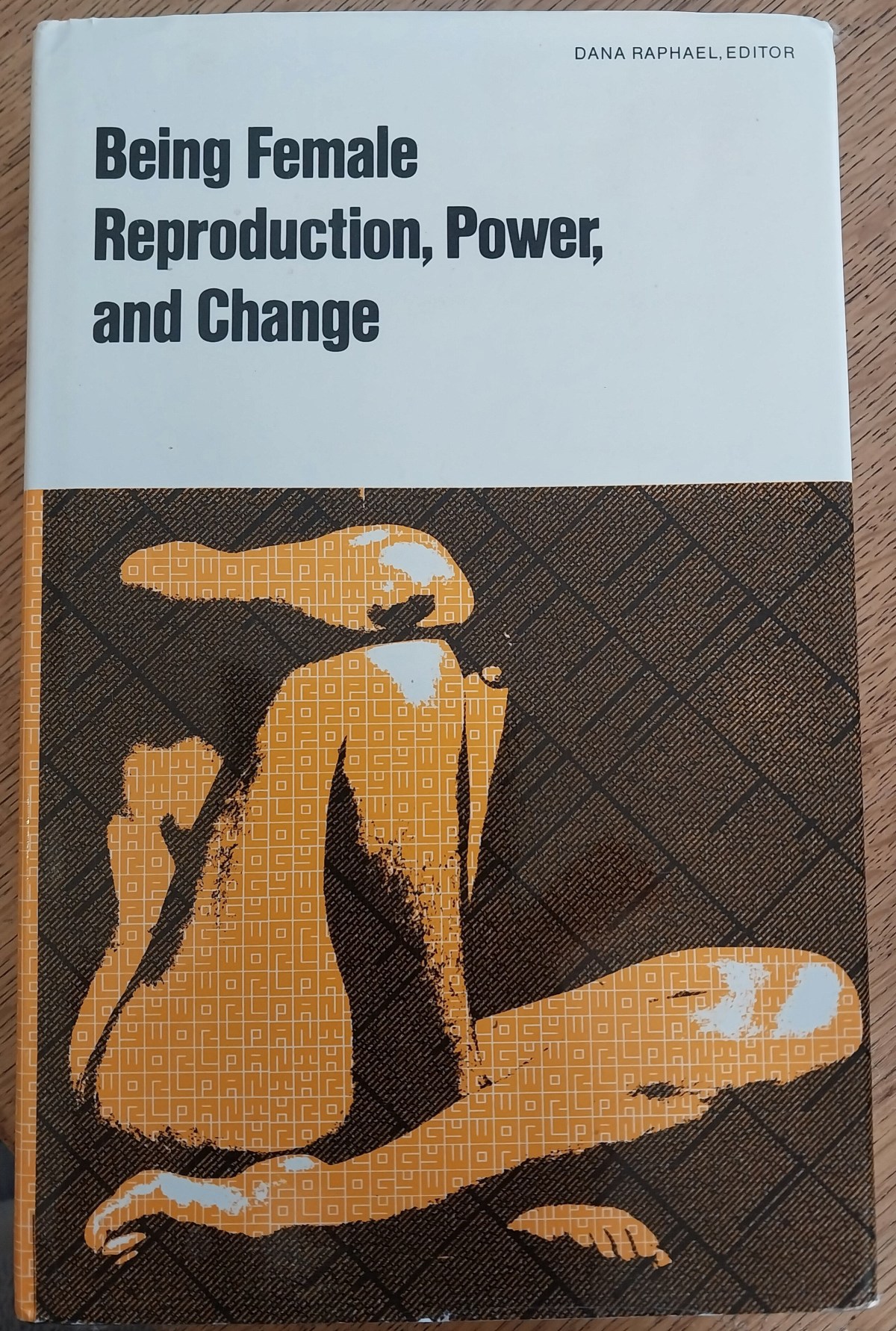
  • What would we find if we checked in to see how this is still in line with Dana Raphael’s (1975) original anthropological concept of matrescence?
  • And do we even care if it does, or doesn’t?
  • Why does it matter, anyway?

For me, it’s a big ‘yes!’, and I’ve spent years working this out to satisfy my own curiosity. In fact, it’s so important to me that I’ve just written a few chapters in the textbook about it! But, if this doesn’t feel important to you, I totally understand.

I think what brings us together is that, for so long, we’ve needed a radical shift to bring mothers back to the centre of medicalised maternity systems. These systems have transformed childbirth and reproductive health in ways that have radically improved health and mortality outcomes for birthing women and infants. But medicalised management of maternity and perinatal care does not offer a perfect or complete solution for the incredibly complex phenomenon of mother-becoming.

The cost of over-medicalised maternity care sits in our (birthing mother’s) needs being reduced to a narrow ‘reproductive health’ lens. This narrow focus often shuts out the emotional, relational, occupational, and existential realities of becoming a mother. Too many women are left feeling objectified, disempowered, or traumatised in being seen only as vessels for reproduction, not as whole human beings. Yes, it’s a huge problem. But it’s not the only factor influencing women’s wellbeing during matrescence.

We are living in a world that often defines success through competition, ownership, and individualism. In this environment, novel and under-explored concepts – like matrescence – can get swept up, polished, and repackaged in ways that strip them of their origins, nuance, and power. I worry that Dana Raphael’s original framing of matrescence in anthropological, relational, and feminist understandings is getting lost in the churn.

As a researcher and academic, I’ve come to understand that my role isn’t to make things easier to hear. It’s to explore complexity with curiosity, to question the narratives we take for granted, and to report on – and do what I can – to hold space for the ideas that haven’t yet found words. So I’m writing this as an academic, and also as a woman and someone who feels a responsibility to speak in a way that encourages others to keep thinking, feeling, and growing, too.

So. I would argue that matrescence isn’t something we need to own, reduce, or contain.

I think what Raphel’s (1975) and Newman’s (1975) original research offered us is a conceptual phenomenon that recognised mother-becoming phase as a rite of passage and socialisation process. The gift in this concept is the we now have a framework to understand motherhood-related challenges and needs that does not pathologise. From an OT perspective, we can see that matrescence is a lifelong, layered, culturally shaped process of having, doing, being, becoming, belonging, and interacting. It’s about identity, care, power, and meaning at the intersection of a female reproductive person and the society they are living in. And unless we’re willing to explore the full concept of matrescence beyond Westernised narratives of motherhood ideals, we risk replicating the very systems that have historically sidelined mothers, (m)others, and mothering, from broader conversations about what it means to be human.

So if matrescence doesn’t start with pregnancy—when does it start?

Dana Raphael’s original conceptualisation of matrescence (1975) invites us to understand mother-becoming as a lifelong, culturally embedded process. It’s not something that begins with a baby. It likely starts much earlier, perhaps in infancy. From an occupational therapy perspective, we can observe how, from the moment a girl is identified or raised as female, subtle messages about care, responsibility, and ‘being a good girl’ begin to shape her occupation-based development. These influences show up in the toys she’s given, the way she’s spoken to, the clothes she wears, the stories she hears, and the roles she sees women performing around her.

Over time, these early and often unspoken cues begin to shape her internalised sense of what it means to mother, or how she is expected to mother, and whether she eventually chooses to have children, is unable to, or is pressured, coerced, or even forced into motherhood. Matrescence, in this broader sense, is not reserved for birthing mothers. It is deeply intertwined with identity, gender, power, societal roles, and cultural values.

When does matrescence end? As a mother, is this even possible?

Perhaps it shifts again during menopause? This life phase seems to be characterised as quiet, confronting transition where society’s gaze often turns away and women begin to feel invisible as they are no longer capable of repoduction. Or perhaps matrescence takes on new form through grandmothering, caring for adult children, or reconfiguring identity after active parenting ends? Maybe we can see matrescence in late life as existential reflection: Was I a good enough mother? What kind of (m)other was I? What legacy have I left behind?

These questions don’t always have answers – and I’m certainly not the authority to say so – one way or the other. But I do think we need to recogise matrescence is not exclusive to women who have birthed or raised children. These questions about matrescence and mothers are uniquely personal in the minds and bodies of all women who navigate a world that continues to measure them against motherhood- whether they embrace, resist, grieve, or reimagine that identity.

There are no neat lines here. Perhaps that’s the point?

Occupations of matrescence: A lifespan perspective

Without repeating the content already explored in our textbook chapters on the occupational nature of matrescence, I’ve used ChatGPT to help generate a brief list of occupations across the lifespan that illustrate how matrescence is expressed, shaped, and experienced through what women and girls do and navigate.

  • Childhood: Role play with dolls or domestic toys, helping care for younger siblings, receiving gendered praise or responsibilities.
  • Adolescence: Babysitting, navigating menstruation and reproductive health education, internalising cultural ideals of ‘good womanhood’ or ‘good motherhood’.
  • Young adulthood: Fertility planning or contraception management, navigating relationships, identity, and societal expectations, choosing or resisting pathways to motherhood and mothering
  • Perinatal transitions (if relevant): Pregnancy care and birthing, infant care co-occupations (feeding, settling, bonding), reorganising daily routines and occupational roles
  • Parenting years: Coordinating care (home, school, health), emotional labour, boundary-setting, advocacy, shaping family rituals, values, and rhythms
  • Menopause and identity shifts: Navigating the end of reproductive years and hormonal transitions, reframing self-worth and womanhood beyond fertility, letting go of certain mothering roles, while renegotiating others, adapting routines, roles, and occupations in response to physical, emotional, and social changes, responding to cultural invisibility (or resisting it) through advocacy, creativity, or reclamation
  • Midlife transitions: Identity shifts as children grow or leave, caregiving for ageing parents or extended family, reclaiming personal occupations
  • Later life: Grandmothering or mentoring roles, reflecting on life meaning and motherhood legacy, engaging in memory work, storytelling, and legacy-building
  • End of life: Reviewing matrescent identity in spiritual, emotional, or relational terms, processing unresolved mothering experiences, shaping how stories of (m)othering are remembered

Matrescence is not a stage or transition. It’s not a medical condition or a milestone to tick off. It’s a rite of passage and transformative phenomenon that is culturally defined and socially contextualised, complex, and nuanced. If we can resist reductionism and simplification, matrescence offers us a humanistic framework to think beyond medicalisation and clinical timelines, normative milestones, and baby-focused care models.

Matrescence is a lifelong process of having, doing, being, becoming, belonging, and interacting. It’s a shifting landscape of individual, reproductive, social, cultural, and political identity. A negotiation between the internal and external, the private and systemic influences. It is complex, nuanced, transformative, and ever-changing. It’s woven through the stories women carry across the lifespan, and – I argue – must not be reduced through a colonised, Westernised, medicalised lenses that are hyper-focused on childbirth and perinatal health. Do we resist this? What happens if we done?

By broadening our reflections on how our sense of self, meaning, and belonging is shaped across the lifespan and in relation to systemic influences, we can start to explore matrescence for individuals and our communities – because it’s not always about the individual. From an occupational therapy perspective, we can think about this in noticing the roles we’re handed, the ones we grow into, and the ones we are expected to perform without question – as well as the roles we’re asking of others and the how medicalisation and colonisation may be influencing our practices.

Where to from here?

Thank you for being curious and open enough to sharing learning on this journey. We’re all still in the early days of learning about matrescence and what it means for ourselves, our children, our communities, and our professions, and hopefully we can continue to do this together.

If you’re curious about what you think but don’t have clear ideas, perhaps start by asking yourself:

  • When did your understanding of motherhood- or (m)otherhood – begin?
  • What messages did you grow up with about what women should do, be, or become?
  • How do those messages show up in how you speak, act, care, or work?
  • Who were the mother figures – or (m)others – in your life? What roles did they play in shaping your sense of self, safety, or belonging?
  • What do you expect of mothers today? What do you expect of yourself?
  • How do you talk about care? Who do you see doing it? Who do you assume will?
  • When you think of matrescence, whose experiences are included in that picture? Whose are missing?

There’s no pressure to answer. And certainly no judgement. We all have an open invitation to keep wondering, learning, and growing our individual and shared understanding of matrescence.

If you really connect with this term, I gently encourage you to seek out Raphael’s original text. It’s out of print, but I bought my copy second-hand, many public libraries still hold copies. I’ve included as much reference to Raphael’s (1975) and Newman’s (1975) works as I could in my upcoming textbook, but reading it at the source is so important for genuine understanding.

In the next post, we’ll gently turn the question around and ask, ‘what does it mean to become a father, and what is patrescence? Does it even exist…?’. And who are we to even ask these questions…?!

Key source references:

Newman, L. (1975). Reproduction: Introductory notes. In D. Raphael (Ed.), Being female: Reproduction, power, and change (pp. 7-12). Mouton Publishers.

Raphael, D. (1975). Matrescence, becoming a mother: A “new/old” rite de passage. In D. Raphael (Ed.), Being female: Reproduction, power, and change (pp. 65-72). Mouton Publishers.