

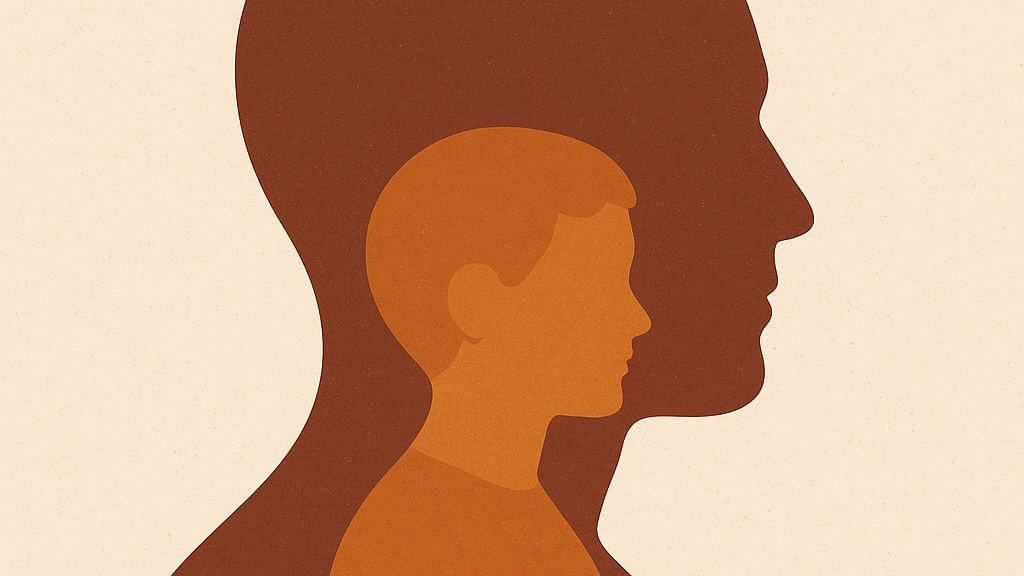
(A quiet invitation to reflect)
We’re starting to talk more openly about matrescence as a complex, layered process of becoming a mother across the lifespan, and also during perinatal transitions. But what about patrescence?
We don’t hear much about it, and it hasn’t been developed in research. From a feminist perspective, I think that silence matters.
Recently, I had the privilege of meeting and chatting with a fellow OT pracademic who is also a father, a man, and a deeply respectful and thoughtful human. He’d given patrescence a lot of thought, and our conversations were really thought-provoking. After these discussions, I feel like it’s ok to write this post (fingers-crossed, Rob!). Even though I still feel that defining or speaking for patrescence is outside my scope, I also believe that opening space for the conversation matters.
So, first up – I want to make it clear that this post isn’t here to define the occupational nature of patrescence with certainty, and it’s certainly not to compare gendered roles. It’s also written with full acknowledgement of mothers and parents and non-binary parenting roles- respecting that mother, father, and parent roles form part of the whole picture. The purpose of writing this post is to hold space to acknowledge patrescence and spark a conversation or two on this specific topic.
As a woman, a mother, and someone who works and researches occupational therapy in women’s health and wellbeing, it’s not my place to tell men what the research says about what patrescence is or fatherhood means in society. But I do want to ask questions. Because I think there’s something missing in how we talk about father-becoming, and wonder if it’s time we made some space for it?
I’m not writing this post with any references because I don’t want this to be part of my research. I don’t feel it’s my place. I hope that someone in a different position than I am will read and be inspired by this post to pick up this concept and explore it – not to argue with what I’ve written, point out typos, or pick apart my positionality or obvious biases – but to sit with the moment and recognise the opportunity to find their own path and help us all understand how fatherhood can be supported through patrescence.
If matrescence begins in childhood – what about patrescence?
As discussed in my previous post and textbook – girls are often socialised into caring/mothering roles from a young age. Through play, clothing, language, praise, and cultural narratives, they are slowly shaped into people expected to nurture. They are given dolls, prams, and kitchen sets. They’re taught, subtly and overtly, that their value lies in helping, caring, softening, and serving.
So what are boys given?
Trucks. Tools. Action. Power. Speed. Risk. Leadership. Comedy. Rough-and-tumble. Sport. Independence. Dirt. Sticks. Anything coloured blue, green, or brown.
Of course, these are broad generalisations – shared not as universal truths, but as starting points. They’re offered to set the scene and open space for conversation, reflection, and deeper questioning. Every story is unique, and the nuances matter. The questions we’re focusing on are – What happens when encouraging nurturing occupations aren’t part of boyhood? When caring is seen as feminine, or weak, or extra? Perhaps we’re socialising boys that caring roles should be outsourced? What is being practised in boyhood occupations and roles that supports their development into future caregiving roles? How are systematic influences shaping this?
If we take patrescence as seriously as matrescence, then father-becoming deserves more than a fleeting moment, tokenistic acknowledgement, or symbolic gesture. It is an identity shift, and a profound and potentially lifelong developmental process. But where is the cultural scaffolding to support that? What rituals, transitions, or shared understandings help men make sense of who they are becoming as fathers? And does it even exist in our society? And – with fingers crossed – could understanding patrescence help us work together to better address gendered family violence?
I’ve spent years thinking about matrescence, but – after having a few recent chats with Rob – I find myself wondering in more depth about what the patrescent rites of passage look like for fathers in our society? I first think of the stereotypical of rituals like sharing cigars, making a proud phone call, or the ‘it’s a boy’ announcement. But beyond these gestures, what deeper rituals exist to honour the transformation of becoming a father? And how can we talk about fathers, men, and boys in the same kind of gender-responsive way that the World Health Organization (WHO) is recommending for mothers, women, and girls?
To step to the side a little to find a safe place to step into this conversation- let’s go to Disney movies. The first image that comes to my mind when I think about father-becoming is that iconic moment in The Lion King, when Mufasa stands tall on Pride Rock as his newborn son, Simba, is lifted high into the sky by Rafiki. The sun breaks through the clouds. Music swells. Animals from across the kingdom bow in reverence. All eyes are on the father and his son as the next in line. It’s a scene rich with symbolism: power, legacy, pride, and masculine leadership. Mufasa says nothing, yet his presence is monumental. In that moment, fatherhood isn’t about the day-to-day labour of care, it’s about visibility, recognition, strength, and inheritance. It’s a symbolic cultural performance of identity and status, witnessed by all.
Viewed through van Gennep’s anthropological rites of passage lens, we can reflect on how this scene could be read as a ritual of patrescence. Similar to parturescence (the theory that a woman is transformed into a mother through childbirth), Mufasa is instantly transformed into The Father when his son is born. The act of presentation marks a separation from pre-fatherhood. The moment is liminal, a threshold between who he was and who he now must be. Though silent, his role is active – accepting responsibility, welcoming the child, stepping into a renewed identity. Finally, the ritual affirms his incorporation into a new social role- as father, guide, protector. In this framing, patrescence is not just biological – it’s symbolic, moral, and cultural. It’s a shift that should be acknowledged, supported, and witnessed.
Well. There’s a lot we could unpack about that, but instead… stepping back from the safety of Disney and back into the hot water zone of reality, we need to ask – what does this look like for men in contemporary societies?
Patrescence across the lifespan: A quiet becoming?
Just as I did with my previous post about matrescence, I’ve asked ChatGPT to help develop a list of what the occupational nature of patrescence might look like across the lifespan. Here’s a list of what we came up with:
Childhood: Receiving early messages about what it means to ‘be a man’, a ‘provider’ or ‘be ‘strong’. Engaging in play that may emphasise action, power, leadership, or independence. Rarely invited into caregiving roles, yet quietly observing care all around.
Adolescence: Forming identity in relation to masculinity, sexual virility and competence, emotion, and responsibility. Navigating social norms around dominance, control, autonomy, and emotional expression. Encountering expectations about future roles as providers or protectors.
Young adulthood: Reflecting on what kind of partner or father one might want to be. Deciding (or being expected) to take on fatherhood, biologically or otherwise. Beginning to shift self-concept as care, stability, and legacy enter awareness.
Fathering transitions: Demonstrating fertility. Experiencing the birth or arrival of a child. Negotiating role changes in relationships, work, time, and identity. Moving from imagined fatherhood to embodied responsibility and care. Being socialised into (or isolated from) parenting communities.
Middle-aged adulthood years: Recalibrating identity as children grow and become independent. Moving from ‘doing’ care to ‘holding space’ as a mentor or steady presence. Grieving missed moments, lost relationships, or unmet ideals. Sometimes stepping into care for ageing parents or community roles.
Later life: Becoming a grandfather, mentor, or elder. Reflecting on fatherhood- What did I pass on? Who have I become? Seeking peace with past decisions, absences, or transformations. Engaging in legacy-building through story, presence, or quiet reconciliation.
Like always, using ChatGPT is was a bit of fun – and I think the earlier Lion King questions may have left a trace – so we’re not taking it too seriously. I’m not proposing this is the whole picture or that this is evidence to help define patrescence. I’m offering this discussion as an open invitation for us to check in and get curious together. Are there any points of this that feel right? What else is there? What’s missing? And what would it mean to honour fathers becoming more broadly from a lifespan perspective through patrescence?
Is fatherhood optional?
Matrescence is often expected, positioned as the natural outcome of womanhood and female-gendered individual’s role in society. Patrescence, on the other hand, seems culturally and socially optional, and I would argue that successful ‘good fathering’ is not measured or subjected to moral judgement in the same way that ‘good mothering’ is. There’s loads of reasons for this, which we know. It’s celebrated when done well, but not expected in the same way. And certainly not morally policed with the same intensity.
This difference matters.
Because while many men become fathers, not all experience a deep identity transformation in the process, and society doesn’t necessarily expect them to or hold them to account with idealised standards. Fatherhood doesn’t come with the same structural pressures or emotional labour that mothers are socialised into.
But what if it did?
What might patrescence look like?
If we imagined patrescence as a real, meaningful developmental process, what kinds of occupations would support it?
- Learning how to care, emotionally and practically
- Reflecting on identity, time, and responsibility
- Navigating societal expectations of masculinity
- Forming new routines, relationships, and priorities
- Processing personal experiences of being fathered (or not)
- Choosing the kind of father, co-parent, or caregiver they want to become
These are quiet tasks. Internal shifts. Often invisible. But I think they matter, and as much as matrescence.
What’s stopping us from talking about this?
Is it discomfort? Is it the assumption that men don’t care, or don’t want to reflect? Is it that we’ve normalised the emotional outsourcing of parenthood to mothers? Or that we’re still not quite ready to redefine masculinity in ways that anchor gender-responsive care for men and fathers?
For me, I don’t know. But I definitely feel the discomfort. And, being really honest – it scares me to talk about and explore. It certainly doesn’t feel like a safe space, and it’s not a topic I’m keen to research or discuss any further than this post.
In saying this, I think there are some uncomfortable questions we all need to explore, and I suspect they are deeply important. Not just for men and fathers, but for all of us.
I guess we won’t create space for patrescence until we’re willing to talk about the societal behaviours, patriarchal norms, and cultural conditions that have left it undeveloped, under-supported, and largely unnamed.
What now…? Let’s start by asking ourselves questions.
- What were the early messages you received about what fathers do, or don’t do?
- Who taught you how to care? What did that look like?
- How do we (as a society) prepare boys to become fathers? Do we prepare them at all?
- What expectations do we place on men who choose to care deeply and show up emotionally?
- What assumptions do we make about who will carry the emotional load of parenting?
- What might change if we saw father-becoming as a process, not a performance?
No answers. Just reflection.
This post is simply an invitation to start asking different questions. Patrescence may not yet be widely recognised, but that doesn’t mean it doesn’t exist or isn’t happening. Are we ready to create space to understand it? Is there any need? How could it help the world become a better place by addressing injustices from an equity perspective?
No answers from me on this one. Just an invitation for conversation and reflection.
What do you think?
 Research & evidence-based practice for OTs in perinatal health, motherhood, and matrescence