Blog

The perinatal rites of transition within matrescence: Finding a common framework and language for OTs in maternity care

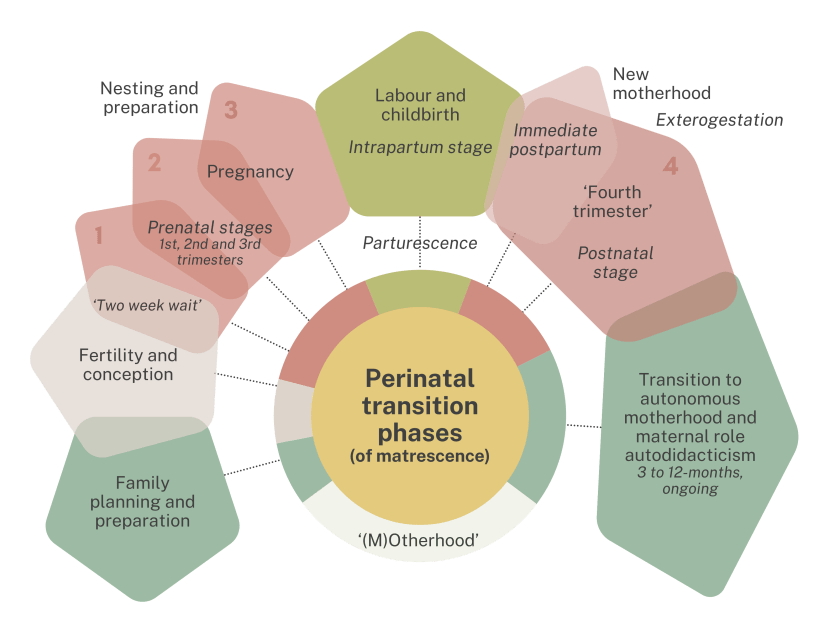
Reprinted with permission: Figure 10.1 A rite of transition: The chronological pathways, milestones, stages, and phases of perinatal transitions, from p. 255 of Slootjes, H. (2025). The perinatal transitions of matrescence: An occupational therapy perspective. In H. Slootjes (Ed.), Enhancing women’s wellbeing during matrescence, motherhood, and perinatal transitions: An evidence-based guide for occupational therapists (pp. 237–260). Routledge. https://doi.org/10.4324/9781003397724-12.

Again, it’s a bit different…

I’m writing this blog post again with a bit of a different lens. It’s following on from the previous post about the occupational nature of matrescence – taking a lifespan perspective – shifting our focus to understand how we contextualise our practices supporting mothers and birthing people during perinatal transitions.

I’m feeling motivated to do this after getting some feedback this week that textbooks are intimating for a lot of people – and that the knowledge translation goal for me is super important. This one ended up being be a bit of longer post – which I hope isn’t a deterrent! Anyway, here goes… 🙂

So, again, we know the perinatal period is often treated as a short, clinical window of time, bracketed by birth statistics and developmental outcomes, and postnatal checklists. I want to make it clear that I’m not dismissing the importance of these – medical advancements have absolutely revolutionised options and outcomes associated with fertility and birth in many incredible ways – and I, for one, certainly wouldn’t be alive without them! Of course they’re not perfect, and – irrespective of funding – women within these systems definitely have needs which could be better met with full MDT input, including OTs.

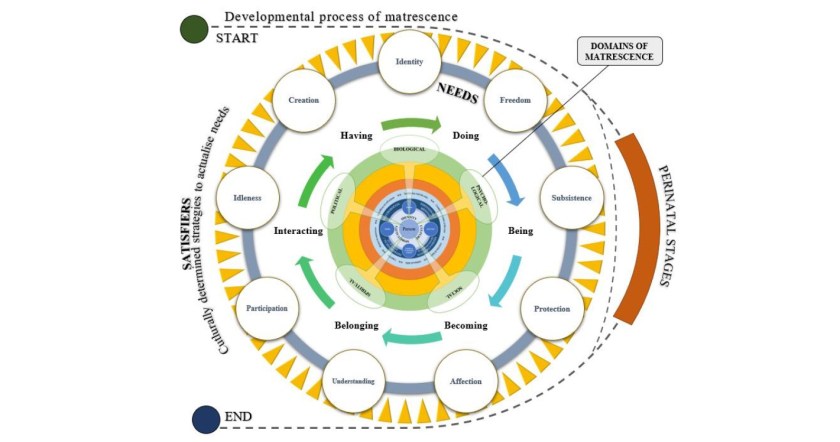
Internationally, OTs are practicing with clients during the perinatal period, and we’re bringing our own unique lens to understanding needs and challenges during this transitional phase (my PhD research are findings represented by illustrative interpretation in Figure 17).

Reflecting on feedback I received about the Person-centred Occupational Model of Matrescence (POMM) (see Figure 17 from my PhD thesis below) – which mapped how occupational therapists can support women and families through these transformative phases by recognising the ecological, cultural, and deeply human dimensions of mother-becoming – it seemed important to really break down what this meant for OTs who were working with mothers during perinatal transitions.

Reprinted Figure 17: Proposed model of conceptual practice: The Person-centered Occupational Model of Matrescence (POMM), from p. 306 in Slootjes, H. (2022). The Role of Occupational Therapists in Perinatal Health [Doctoral thesis, La Trobe University]. Open Access at La Trobe (OPAL). https://doi.org/10.26181/19836172.v1.

After completing my PhD, I was lucky and privileged enough to have the space and opportunity to explore this further in a textbook chapter, The Perinatal Transitions of Matrescence: An Occupational Therapy Perspective (Slootjes, 2025). When we zoom out through a person-centred occupational lens, the perinatal period looks a bit different. From this perspective, the perinatal period is not a single event but a fluid series of transitions nested within the larger journey of matrescence (the ongoing, lifelong process of becoming [or not becoming, or even letting go of being] a mother).

Seeing the perinatal period as rite of transition, not timeline

While the POMM doesn’t feature much in the textbook, Figure 10.1 A rite of transition: The chronological pathways, milestones, stages, and phases of perinatal transitions – continues developing the idea that perinatal period is non-lineal and a continuum. This was developed to reflect what we see as OTs when we support someone through perinatal transitions, backed by evidence-based concepts in scientific literature.

It’s the lens that shapes our worldview for a certain time during matrescence (illustrated in Figure 17 of the POMM), and is characterised by so many occupational factors relating to loss, hope, fear, dread, gain, progress, and set-backs, expectations, circumstance, choice, recovery, healing and responsibility.

These can occur during any phase, from family planning and conception through pregnancy, labour, postpartum recovery, the early experiences of motherhood, and the period thereafter where mothering occupations shift to a more autodidactic phase. Each phase carries its own occupations, milestones, and rituals: nesting, preparing, birthing, healing, adjusting, learning, letting go.

This framing invites us to think less about rigid concepts of step-by-step “stages” and more about how individuals move through, circle back, or diverge from these transitions in their own time and way. Some pathways are linear, others are interrupted, cyclical, or nonlinear – either by choice or circumstances outside of control. Each tells a story about hope, fear, anticipation, resilience, identity, and adaptation.

Occupational therapy brings language to these lived experiences – recognising that having, doing, being, becoming, belonging, and interacting are central to how mothers navigate these phases (Slootjes, 2022). It’s a trick, really, because – as OTs – this kind of approach doesn’t fit neatly into existing maternity care services where there’s rarely funding for full allied health teams. But we do have a lot to offer the women who need our help. Many of us are responding by shifting into private practice to increase our availability for perinatal clients, and things will undoubtedly change as the evidence base for our services grows.


A rite of transition, not just a healthcare event

Across cultures, childbirth has always carried ritual significance – acts of protection, preparation, and communal care. In modern healthcare, many of these rituals have been replaced by routines: Discharge summaries, feeding schedules, medical follow-ups (Davis-Floyd, 2022). However, as Grimes (2000) reminded us, humans have a deep need to ritualise transformation.

Occupational therapists see rituals as meaningful occupations – the gestures that help women situate themselves within change. Lighting a candle before birth, crafting a nursery or nesting, giving gifts, writing a reflection after miscarriage, or sharing a baby’s “firsts” with community – each of these acts holds the power to integrate experience and identity.

When services make space for ritual and reflection, not just medical monitoring, the perinatal period becomes opportunity for supported rite of transition or a rite of passage – depending on the birthing person’s unique positionality and culture, and circumstances.


The five developmental domains in practice

During perinatal transitions, mothers experience changes across five developmental domains, all dynamically interacting within their ecological context:

  • Biological/physical: Transformation of the body’s systems and functions, affecting movement, sensation, energy, and participation.
  • Psychological: Emotional regulation, identity formation, neurobiological and cognitive shifts.
  • Social:/psychosocial Relationships, role negotiation, community expectations, and the occupational reorganisation of daily life.
  • Spiritual: meaning-making, belonging, and connection to something larger than oneself.
  • Political: the influence of policies, funding, safety, and social structures on how mothering is lived and valued.

From this view, perinatal care is not just about health, it’s about human development, wellbeing, quality of life, occupational adaption, and changing identities, roles, and routines, healthy relationships – and so much more.


When healthcare becomes holistic

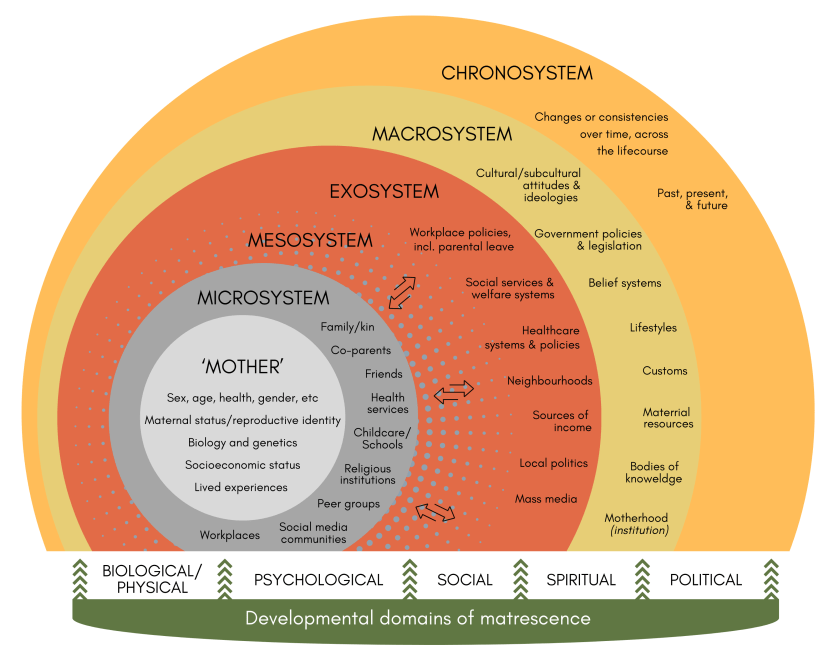
The bioecological lens shared in the previous post about matrescence (Figure 7.1) helps us see how each mother’s experience is shaped by the systems surrounding her – the micro-level of family and co-parents, the meso-level of connected services and communities, the exo-level of workplace and policy environments, and the macro-level of cultural and ideological forces.

Occupational therapists can help bridge these levels, advocating for policies that protect perinatal wellbeing and designing services that honour women’s autonomy, rituals, and lived realities.

Imagine perinatal care that makes room for stories, spirituality, and agency alongside safety, science, and skill. That is what it means to move from “perinatal management” toward perinatal transition support. Things are definitely changing, and the OT workforce are gearing up and to get ready for the opportunities that are coming!


Questions we can ask ourselves as a reflection to guide future practice

  • What would it look like if we all treated the perinatal period as a rite of transition, rather than a clinical event?
  • How might we hold space for mother’s having positive experiences having, doing, being, becoming, belonging, and interacting during perinatal transitions, beyond focusing to ‘treat’ medical issues?
  • And how might we design care, education, and policy that reflect the full ecology of matrescence rather than just its medical margins?

Because the perinatal period does not define mother-becoming, and also is not the beginning or end of matrescence – it’s one incredible point of transition (and sometimes transformation) along the way. What do you think?


Key references
Davis-Floyd, R. (2022). Birth as an American rite of passage (3rd ed.). Routledge. https://doi.org/10.4324/978100300139

Grimes, R. L. (2000). Deeply into the bone: Re-inventing rites of passage. University of California Press.

Slootjes, H. (2022). The Role of Occupational Therapists in Perinatal Health [Doctoral thesis, La Trobe University]. Open Access at La Trobe (OPAL). https://doi.org/10.26181/19836172.v1.

Slootjes, H. (2025). The perinatal transitions of matrescence: An occupational therapy perspective. In H. Slootjes (Ed.), Enhancing women’s wellbeing during matrescence, motherhood, and perinatal transitions: An evidence-based guide for occupational therapists (pp. 247–274). Routledge. https://doi.org/10.4324/9781003397724-12
Let’s stop reducing matrescence to the perinatal window, and take a humanistic, gender-responsive, lifespan approach

Reprinted with permission from: Slootjes, H., & DeRolf, A. (2025). The occupational nature of matrescence. In H. Slootjes (Ed.), Enhancing women’s wellbeing during matrescence, motherhood, and perinatal transitions: An evidence-based guide for occupational therapists (p. 187). Routledge. https://doi.org/10.4324/9781003397724-9

This is a bit of a different post from me today. I really want to talk about matrescence and to share a bit about what we’ve included in the textbook to help communicate more about matrescence from an evidence-based perspective.

Matrescence is still in the spotlight! But let’s stop boxing it into the perinatal period and fourth trimester.

So, we know matrescence is not simply a phase around birth. We understand it’s a rite of passage and metamorphosis that unfolds through shifting identities, roles, relationships, resources, bodies, beliefs and power over time (Raphael, 1978). But the desire to anchor back to the perinatal transitions and birth are really strong! So I wanted to use this post to discuss things in a bit more depth.

With permission from Routledge (the publisher) to post the figures in colour, we’re going to revisit my textbook chapter with Annie DeRolf, where we locate matrescence within an occupational lens and a bioecological framework to guard against this reductionism. In short, this chapter talks about how mothers’ development is co-created by what they do and the environments that enable or constrain that doing, from the intimate to the structural, across the whole lifespan. It’s basically OT 101. But we’re taking things up a knotch to the next level to help understand matrescence from an human occupational perspective.

The figure, in two paragraphs

The figure above adapts Bronfenbrenner’s (2006) ecology of human development to matrescence. Imagine nested “dolls” – at the centre sits the mother (in this context, bio = person): Her characteristics, capacities, and experiences. Around her are immediate settings (the microsystem), the interactions between those settings (the mesosystem), the systems that shape her indirectly (the exosystem), and the wider cultural, ideological, and institutional forces, including the patriarchal institution of motherhood itself (the macrosystem). All are held in time (the chronosystem), because matrescence unfolds across a lifetime. It’s illustrative, not exhaustive — a living model.

Across these layers, matrescence develops through interwoven domains – not just bio-psycho-social, but also spiritual and political. Hormones and sleep. Identity and mental health. Kinship and work. Digital communities, rites of passage, belonging, policy, money, safety, gendered power. These forces wax and wane across time and intersect across diverse mothering pathways – birth, adoption, fostering, kin and community mothering, and other care roles. Together, these factors intersect and evolve over time to continuously shape girls and women’s health, wellbeing, and quality of life – as gendered beings navigating the culturally nuanced rite of passage of matrescence.

What gets lost when we reduce matrescence to “perinatal”?

  • Lifespan context | Mothering is a lifetime occupation and matrescence is a lifelong socialisation process that is culturally bound. The diversity of challenges and meanings associated with navigating mothering roles/identities and motherhood start from the birth of a female child and continue to evolve over time – often spiking again with the onset of menstruation and/or puberty, during perinatal transitions, grandmothering, onset of menopause, and end of life transitions. Collapsing matrescence into a perinatal episode erases these rich cumulative transitions of separation, adaptation, change, and consolidation.
  • Structural determinants | Perinatal services rightly focus on mortality and clinical needs, but mother’s wellbeing is also shaped by housing, income, leave, childcare, safety, relationships and psychosocial factors, local politics and cultural ideologies. If matrescence is treated as a clinic-only matter (a health perspective), upstream levers will get ignored (the wellbeing perspective).
  • Diverse mothering | There is no universally correct way to mother. Mothering is distinct from parenting or fathers, and not synonymous with motherhood as an institution. Mothering experiences range from joyful to catastrophic. Roles may be shared, non-biological, chosen, or imposed. Narrow perinatal framings can erase (m)others, queer parents, kin-care, and culturally distinct rites of passage.
  • Agency and identity | Matrescence is not just something that happens to women in midlife – it’s an ongoing socialisation and practice that deeply culturally nuanced. Matrescence is often characterised by an accumulation of occupations and co-occupations that build – or strip – female agency in relation to motherhood. Reducing matrescence to the perinatal period for screening and symptom management has capacity to strengthen mother-centred care, however overlooks complexity, individuality, meaning, mastery, and power from a lifespan perspective.

A wider, wiser brief for practice and policy

The mother-centred approach suggested by Neely & Reed (2023) can help us to reframe services around mothers’ lived contexts, not just diagnoses – connecting local systems, building parenting skills inclusively, addressing upstream determinants – to fund flexible, equitable support; and investing in real-world “villages”, both face-to-face and digital. This multi-level strategy pairs naturally with the bioecological view in the figure and protects us from siloed, perinatal-only thinking.

So, what can we do now?

First things first. Let’s stop and take a moment to pause and reflect.

  • Clinicians and practitioners – Before we reach for diagnostic maps, perhaps we can pause to map the mother’s world. What surrounds her? What sustains or drains her energy each day? The home, the workplace, the care spaces between. The policies that influence her “choices”. The cultural stories that quietly tell her who she should be as a gendered female being in society – or who she has failed to be, and in what way she isn’t meeting sociocultural nuanced expectations as an idealised ‘mother’. When we notice the life stage or phase she’s in, as well as intergenerational and bioecological factors, a fuller picture of her wellbeing needs and challenges begins to emerge.
  • Educators and researchers – Maybe it’s time to expand how we hold matrescence in our teaching and inquiry? Not as a chapter tucked into perinatal care, but as a lifelong unfolding – social, cultural, political, spiritual, and deeply occupational. When we frame it this way, we give language and legitimacy to the slow transformations that mothers live long after the baby books end.
  • Policymakers and leaders – To truly support mothers, we might begin not with programs, but with the environments that make mothering possible. Safe housing. Paid leave. Affordable childcare. Flexible work. Freedom from violence. Cultural safety and community. These are not extras – they are the ecosystem of matrescence and the gendered context influencing wellbeing determinants.

We can’t change everything, but we can definitely take accountability for our own practices and prioritise an evidence-based perspective that responds to women as human occupational beings.

Matrescence is a gendered human developmental story and a concept developed through anthropological research. From an occupational perspective, we can recognise matrescence is lived through occupations, relationships and structures, across time. When we hold that human occupational breadth, we can understand why we need to hold the perspective that perinatal care can fill one strong chapter without dominating the whole book.


Further reading: This post heavily summarises ideas from our chapter, The occupational nature of matrescence (Slootjes & DeRolf 2025), where we situate matrescence within an occupational and bioecological framework from an evidence-based perspective. Annie and I invite readers to read our chapter and to critically consider how their understanding of matrescence aligns within the nested systems and matrescence development domains in Figure 7.1, and reflect of how mother-centred health promotion can extend beyond perinatal care.

References

Bronfenbrenner, U., & Morris, P. A. (2006). The bioecological model of human development. In R. M. Lerner (Ed.), Handbook of child psychology: Theoretical models of human development (Vol. 1, pp. 793–828). Wiley.

Neely, E., & Reed, A. (2023). Towards a mother-centred maternal health promotion. Health Promotion International, 38(2), 1–14. https://doi.org/10.1093/heapro/daad014

Raphael, D. (1975). Matrescence, becoming a mother: A “new/old” rite de passage. In D. Raphael (Ed.), Being female: Reproduction, power, and change (pp. 65–72). Mouton Publishers

Slootjes, H., & DeRolf, A. (2025). The occupational nature of matrescence. In H. Slootjes (Ed.), Enhancing women’s wellbeing during matrescence, motherhood, and perinatal transitions: An evidence-based guide for occupational therapists (pp. 121–142). Routledge. https://doi.org/10.4324/9781003397724-9

✨ It’s publication day! ✨

After what feels like the most impossibly long time (2 years, 9 months, and 12 days… but who’s counting?!) I’m so excited to share that Enhancing Women’s Wellbeing During Matrescence, Motherhood, and Perinatal Transitions is officially published today with Routledge!! Woo woo! A truly heartfelt thank you to the 64 incredible contributors, the reviewers, and community who made this possible. This is absolutely a dream come true ✨

I’ve read my copy twice now and am just floored with how proud I am of all of us for coming together to make this collection so broad. I can’t wait to see how it sparks new conversations and practice in the months ahead. I’m nervous, of course! But so excited ✨ And, on reflection, I also keep thinking how much more there is to say, and that each of the practice chapters really needs to be expanded on in individual books. Or perhaps, instead, we go all in for the next edition and bulk it up into a massive, more traditional textbook? I wonder what you will think when you read it…?

If you’re keen to buy a copy of this book, please go to the Routledge website. Due to temporary shipping issues, people in Australia and New Zealand can currently only purchase paperback or hardback copies through Booktopia.

A deep breath for me now, and time to see what happens next… ✨

Patrescence: What does is mean to become a father? And does patrescence even exist in Westernised cultures?

(A quiet invitation to reflect)

We’re starting to talk more openly about matrescence as a complex, layered process of becoming a mother across the lifespan, and also during perinatal transitions. But what about patrescence?

We don’t hear much about it, and it hasn’t been developed in research. From a feminist perspective, I think that silence matters.

Recently, I had the privilege of meeting and chatting with a fellow OT pracademic who is also a father, a man, and a deeply respectful and thoughtful human. He’d given patrescence a lot of thought, and our conversations were really thought-provoking. After these discussions, I feel like it’s ok to write this post (fingers-crossed, Rob!). Even though I still feel that defining or speaking for patrescence is outside my scope, I also believe that opening space for the conversation matters.

So, first up – I want to make it clear that this post isn’t here to define the occupational nature of patrescence with certainty, and it’s certainly not to compare gendered roles. It’s also written with full acknowledgement of mothers and parents and non-binary parenting roles- respecting that mother, father, and parent roles form part of the whole picture. The purpose of writing this post is to hold space to acknowledge patrescence and spark a conversation or two on this specific topic.

As a woman, a mother, and someone who works and researches occupational therapy in women’s health and wellbeing, it’s not my place to tell men what the research says about what patrescence is or fatherhood means in society. But I do want to ask questions. Because I think there’s something missing in how we talk about father-becoming, and wonder if it’s time we made some space for it?

I’m not writing this post with any references because I don’t want this to be part of my research. I don’t feel it’s my place. I hope that someone in a different position than I am will read and be inspired by this post to pick up this concept and explore it – not to argue with what I’ve written, point out typos, or pick apart my positionality or obvious biases – but to sit with the moment and recognise the opportunity to find their own path and help us all understand how fatherhood can be supported through patrescence.

Image generated by ChatGPT

If matrescence begins in childhood – what about patrescence?

As discussed in my previous post and textbook – girls are often socialised into caring/mothering roles from a young age. Through play, clothing, language, praise, and cultural narratives, they are slowly shaped into people expected to nurture. They are given dolls, prams, and kitchen sets. They’re taught, subtly and overtly, that their value lies in helping, caring, softening, and serving.

So what are boys given?

Trucks. Tools. Action. Power. Speed. Risk. Leadership. Comedy. Rough-and-tumble. Sport. Independence. Dirt. Sticks. Anything coloured blue, green, or brown.

Of course, these are broad generalisations – shared not as universal truths, but as starting points. They’re offered to set the scene and open space for conversation, reflection, and deeper questioning. Every story is unique, and the nuances matter. The questions we’re focusing on are – What happens when encouraging nurturing occupations aren’t part of boyhood? When caring is seen as feminine, or weak, or extra? Perhaps we’re socialising boys that caring roles should be outsourced? What is being practised in boyhood occupations and roles that supports their development into future caregiving roles? How are systematic influences shaping this?

If we take patrescence as seriously as matrescence, then father-becoming deserves more than a fleeting moment, tokenistic acknowledgement, or symbolic gesture. It is an identity shift, and a profound and potentially lifelong developmental process. But where is the cultural scaffolding to support that? What rituals, transitions, or shared understandings help men make sense of who they are becoming as fathers? And does it even exist in our society? And – with fingers crossed – could understanding patrescence help us work together to better address gendered family violence?

I’ve spent years thinking about matrescence, but – after having a few recent chats with Rob – I find myself wondering in more depth about what the patrescent rites of passage look like for fathers in our society? I first think of the stereotypical of rituals like sharing cigars, making a proud phone call, or the ‘it’s a boy’ announcement. But beyond these gestures, what deeper rituals exist to honour the transformation of becoming a father? And how can we talk about fathers, men, and boys in the same kind of gender-responsive way that the World Health Organization (WHO) is recommending for mothers, women, and girls?

To step to the side a little to find a safe place to step into this conversation- let’s go to Disney movies. The first image that comes to my mind when I think about father-becoming is that iconic moment in The Lion King, when Mufasa stands tall on Pride Rock as his newborn son, Simba, is lifted high into the sky by Rafiki. The sun breaks through the clouds. Music swells. Animals from across the kingdom bow in reverence. All eyes are on the father and his son as the next in line. It’s a scene rich with symbolism: power, legacy, pride, and masculine leadership. Mufasa says nothing, yet his presence is monumental. In that moment, fatherhood isn’t about the day-to-day labour of care, it’s about visibility, recognition, strength, and inheritance. It’s a symbolic cultural performance of identity and status, witnessed by all.

Viewed through van Gennep’s anthropological rites of passage lens, we can reflect on how this scene could be read as a ritual of patrescence. Similar to parturescence (the theory that a woman is transformed into a mother through childbirth), Mufasa is instantly transformed into The Father when his son is born. The act of presentation marks a separation from pre-fatherhood. The moment is liminal, a threshold between who he was and who he now must be. Though silent, his role is active – accepting responsibility, welcoming the child, stepping into a renewed identity. Finally, the ritual affirms his incorporation into a new social role- as father, guide, protector. In this framing, patrescence is not just biological – it’s symbolic, moral, and cultural. It’s a shift that should be acknowledged, supported, and witnessed.

Well. There’s a lot we could unpack about that, but instead… stepping back from the safety of Disney and back into the hot water zone of reality, we need to ask – what does this look like for men in contemporary societies?

Patrescence across the lifespan: A quiet becoming?

Just as I did with my previous post about matrescence, I’ve asked ChatGPT to help develop a list of what the occupational nature of patrescence might look like across the lifespan. Here’s a list of what we came up with:

Childhood: Receiving early messages about what it means to ‘be a man’, a ‘provider’ or ‘be ‘strong’. Engaging in play that may emphasise action, power, leadership, or independence. Rarely invited into caregiving roles, yet quietly observing care all around.

Adolescence: Forming identity in relation to masculinity, sexual virility and competence, emotion, and responsibility. Navigating social norms around dominance, control, autonomy, and emotional expression. Encountering expectations about future roles as providers or protectors.

Young adulthood: Reflecting on what kind of partner or father one might want to be. Deciding (or being expected) to take on fatherhood, biologically or otherwise. Beginning to shift self-concept as care, stability, and legacy enter awareness.

Fathering transitions: Demonstrating fertility. Experiencing the birth or arrival of a child. Negotiating role changes in relationships, work, time, and identity. Moving from imagined fatherhood to embodied responsibility and care. Being socialised into (or isolated from) parenting communities.

Middle-aged adulthood years: Recalibrating identity as children grow and become independent. Moving from ‘doing’ care to ‘holding space’ as a mentor or steady presence. Grieving missed moments, lost relationships, or unmet ideals. Sometimes stepping into care for ageing parents or community roles.

Later life: Becoming a grandfather, mentor, or elder. Reflecting on fatherhood- What did I pass on? Who have I become? Seeking peace with past decisions, absences, or transformations. Engaging in legacy-building through story, presence, or quiet reconciliation.

Like always, using ChatGPT is was a bit of fun – and I think the earlier Lion King questions may have left a trace – so we’re not taking it too seriously. I’m not proposing this is the whole picture or that this is evidence to help define patrescence. I’m offering this discussion as an open invitation for us to check in and get curious together. Are there any points of this that feel right? What else is there? What’s missing? And what would it mean to honour fathers becoming more broadly from a lifespan perspective through patrescence?

Is fatherhood optional?

Matrescence is often expected, positioned as the natural outcome of womanhood and female-gendered individual’s role in society. Patrescence, on the other hand, seems culturally and socially optional, and I would argue that successful ‘good fathering’ is not measured or subjected to moral judgement in the same way that ‘good mothering’ is. There’s loads of reasons for this, which we know. It’s celebrated when done well, but not expected in the same way. And certainly not morally policed with the same intensity.

This difference matters.

Because while many men become fathers, not all experience a deep identity transformation in the process, and society doesn’t necessarily expect them to or hold them to account with idealised standards. Fatherhood doesn’t come with the same structural pressures or emotional labour that mothers are socialised into.

But what if it did?

What might patrescence look like?

If we imagined patrescence as a real, meaningful developmental process, what kinds of occupations would support it?

  • Learning how to care, emotionally and practically
  • Reflecting on identity, time, and responsibility
  • Navigating societal expectations of masculinity
  • Forming new routines, relationships, and priorities
  • Processing personal experiences of being fathered (or not)
  • Choosing the kind of father, co-parent, or caregiver they want to become

These are quiet tasks. Internal shifts. Often invisible. But I think they matter, and as much as matrescence.

What’s stopping us from talking about this?

Is it discomfort? Is it the assumption that men don’t care, or don’t want to reflect? Is it that we’ve normalised the emotional outsourcing of parenthood to mothers? Or that we’re still not quite ready to redefine masculinity in ways that anchor gender-responsive care for men and fathers?

For me, I don’t know. But I definitely feel the discomfort. And, being really honest – it scares me to talk about and explore. It certainly doesn’t feel like a safe space, and it’s not a topic I’m keen to research or discuss any further than this post.

In saying this, I think there are some uncomfortable questions we all need to explore, and I suspect they are deeply important. Not just for men and fathers, but for all of us.

I guess we won’t create space for patrescence until we’re willing to talk about the societal behaviours, patriarchal norms, and cultural conditions that have left it undeveloped, under-supported, and largely unnamed.

What now…? Let’s start by asking ourselves questions.

  • What were the early messages you received about what fathers do, or don’t do?
  • Who taught you how to care? What did that look like?
  • How do we (as a society) prepare boys to become fathers? Do we prepare them at all?
  • What expectations do we place on men who choose to care deeply and show up emotionally?
  • What assumptions do we make about who will carry the emotional load of parenting?
  • What might change if we saw father-becoming as a process, not a performance?

No answers. Just reflection.

This post is simply an invitation to start asking different questions. Patrescence may not yet be widely recognised, but that doesn’t mean it doesn’t exist or isn’t happening. Are we ready to create space to understand it? Is there any need? How could it help the world become a better place by addressing injustices from an equity perspective?

No answers from me on this one. Just an invitation for conversation and reflection.

What do you think?

More than pregnancy, birth, and motherhood: Matrescence is a lifelong process

Over the past few years, I’ve watched and cheered as the term matrescence has started to gain traction in our collective conversations. We’re still in the early days, but it’s appearing in perinatal care, parenting spaces, academic literature, the press, and social media. More and more people are hearing it, using it, and trying to make sense of it. It’s exciting that a concept can be so important to so many people. We clearly need it.

But as matrescence gains popularity and visibility, I’ve noticed how quickly we’re trying to contain it. It seems the race is on to define it neatly, frame it clinically, and reduce it to something manageable. We’re doing what dominant Westernised, patriarchal, and colonising systems so often do: we’re shrinking a rich, human experience to make it more contained to make it comfortable, more marketable, and more palatable. We reducing matrescence to mean: pregnancy, birth, postpartum, and early motherhood.

Is this really what we want?

Language is incredibly powerful, and matrescence offers us a way out of that reduction. It gives to what so many mothers have long felt but struggled to articulate. It’s a profoundly human, mother-centred concept that validates the complexity of our identities, roles, and emotional landscapes during times of transition – and transformation. So, I’m writing this post as an open invitation to slow down and take a proper pause to reflect on how matrescence is being shaped by our society.

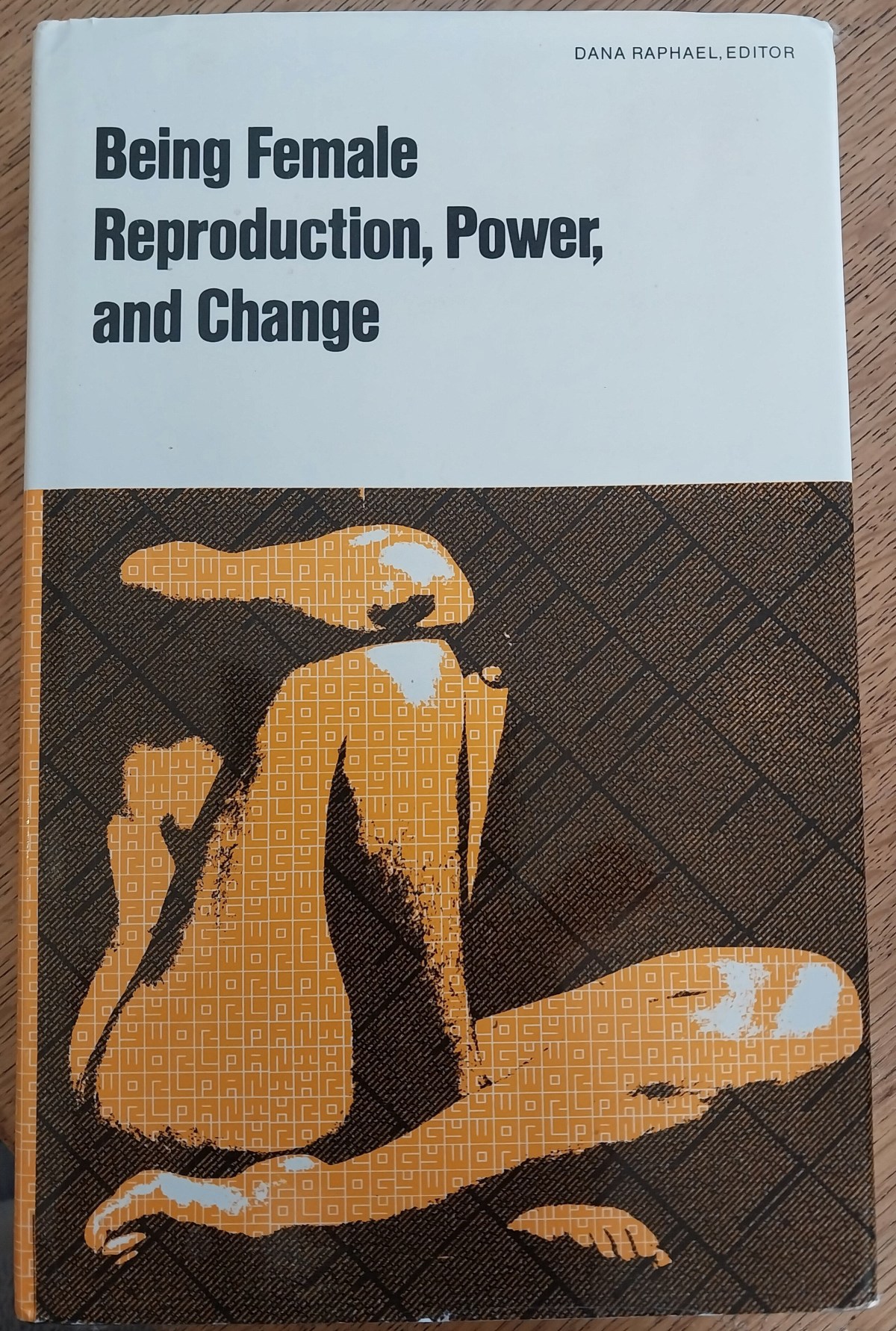
  • What would we find if we checked in to see how this is still in line with Dana Raphael’s (1975) original anthropological concept of matrescence?
  • And do we even care if it does, or doesn’t?
  • Why does it matter, anyway?

For me, it’s a big ‘yes!’, and I’ve spent years working this out to satisfy my own curiosity. In fact, it’s so important to me that I’ve just written a few chapters in the textbook about it! But, if this doesn’t feel important to you, I totally understand.

I think what brings us together is that, for so long, we’ve needed a radical shift to bring mothers back to the centre of medicalised maternity systems. These systems have transformed childbirth and reproductive health in ways that have radically improved health and mortality outcomes for birthing women and infants. But medicalised management of maternity and perinatal care does not offer a perfect or complete solution for the incredibly complex phenomenon of mother-becoming.

The cost of over-medicalised maternity care sits in our (birthing mother’s) needs being reduced to a narrow ‘reproductive health’ lens. This narrow focus often shuts out the emotional, relational, occupational, and existential realities of becoming a mother. Too many women are left feeling objectified, disempowered, or traumatised in being seen only as vessels for reproduction, not as whole human beings. Yes, it’s a huge problem. But it’s not the only factor influencing women’s wellbeing during matrescence.

We are living in a world that often defines success through competition, ownership, and individualism. In this environment, novel and under-explored concepts – like matrescence – can get swept up, polished, and repackaged in ways that strip them of their origins, nuance, and power. I worry that Dana Raphael’s original framing of matrescence in anthropological, relational, and feminist understandings is getting lost in the churn.

As a researcher and academic, I’ve come to understand that my role isn’t to make things easier to hear. It’s to explore complexity with curiosity, to question the narratives we take for granted, and to report on – and do what I can – to hold space for the ideas that haven’t yet found words. So I’m writing this as an academic, and also as a woman and someone who feels a responsibility to speak in a way that encourages others to keep thinking, feeling, and growing, too.

So. I would argue that matrescence isn’t something we need to own, reduce, or contain.

I think what Raphel’s (1975) and Newman’s (1975) original research offered us is a conceptual phenomenon that recognised mother-becoming phase as a rite of passage and socialisation process. The gift in this concept is the we now have a framework to understand motherhood-related challenges and needs that does not pathologise. From an OT perspective, we can see that matrescence is a lifelong, layered, culturally shaped process of having, doing, being, becoming, belonging, and interacting. It’s about identity, care, power, and meaning at the intersection of a female reproductive person and the society they are living in. And unless we’re willing to explore the full concept of matrescence beyond Westernised narratives of motherhood ideals, we risk replicating the very systems that have historically sidelined mothers, (m)others, and mothering, from broader conversations about what it means to be human.

So if matrescence doesn’t start with pregnancy—when does it start?

Dana Raphael’s original conceptualisation of matrescence (1975) invites us to understand mother-becoming as a lifelong, culturally embedded process. It’s not something that begins with a baby. It likely starts much earlier, perhaps in infancy. From an occupational therapy perspective, we can observe how, from the moment a girl is identified or raised as female, subtle messages about care, responsibility, and ‘being a good girl’ begin to shape her occupation-based development. These influences show up in the toys she’s given, the way she’s spoken to, the clothes she wears, the stories she hears, and the roles she sees women performing around her.

Over time, these early and often unspoken cues begin to shape her internalised sense of what it means to mother, or how she is expected to mother, and whether she eventually chooses to have children, is unable to, or is pressured, coerced, or even forced into motherhood. Matrescence, in this broader sense, is not reserved for birthing mothers. It is deeply intertwined with identity, gender, power, societal roles, and cultural values.

When does matrescence end? As a mother, is this even possible?

Perhaps it shifts again during menopause? This life phase seems to be characterised as quiet, confronting transition where society’s gaze often turns away and women begin to feel invisible as they are no longer capable of repoduction. Or perhaps matrescence takes on new form through grandmothering, caring for adult children, or reconfiguring identity after active parenting ends? Maybe we can see matrescence in late life as existential reflection: Was I a good enough mother? What kind of (m)other was I? What legacy have I left behind?

These questions don’t always have answers – and I’m certainly not the authority to say so – one way or the other. But I do think we need to recogise matrescence is not exclusive to women who have birthed or raised children. These questions about matrescence and mothers are uniquely personal in the minds and bodies of all women who navigate a world that continues to measure them against motherhood- whether they embrace, resist, grieve, or reimagine that identity.

There are no neat lines here. Perhaps that’s the point?

Occupations of matrescence: A lifespan perspective

Without repeating the content already explored in our textbook chapters on the occupational nature of matrescence, I’ve used ChatGPT to help generate a brief list of occupations across the lifespan that illustrate how matrescence is expressed, shaped, and experienced through what women and girls do and navigate.

  • Childhood: Role play with dolls or domestic toys, helping care for younger siblings, receiving gendered praise or responsibilities.
  • Adolescence: Babysitting, navigating menstruation and reproductive health education, internalising cultural ideals of ‘good womanhood’ or ‘good motherhood’.
  • Young adulthood: Fertility planning or contraception management, navigating relationships, identity, and societal expectations, choosing or resisting pathways to motherhood and mothering
  • Perinatal transitions (if relevant): Pregnancy care and birthing, infant care co-occupations (feeding, settling, bonding), reorganising daily routines and occupational roles
  • Parenting years: Coordinating care (home, school, health), emotional labour, boundary-setting, advocacy, shaping family rituals, values, and rhythms
  • Menopause and identity shifts: Navigating the end of reproductive years and hormonal transitions, reframing self-worth and womanhood beyond fertility, letting go of certain mothering roles, while renegotiating others, adapting routines, roles, and occupations in response to physical, emotional, and social changes, responding to cultural invisibility (or resisting it) through advocacy, creativity, or reclamation
  • Midlife transitions: Identity shifts as children grow or leave, caregiving for ageing parents or extended family, reclaiming personal occupations
  • Later life: Grandmothering or mentoring roles, reflecting on life meaning and motherhood legacy, engaging in memory work, storytelling, and legacy-building
  • End of life: Reviewing matrescent identity in spiritual, emotional, or relational terms, processing unresolved mothering experiences, shaping how stories of (m)othering are remembered

Matrescence is not a stage or transition. It’s not a medical condition or a milestone to tick off. It’s a rite of passage and transformative phenomenon that is culturally defined and socially contextualised, complex, and nuanced. If we can resist reductionism and simplification, matrescence offers us a humanistic framework to think beyond medicalisation and clinical timelines, normative milestones, and baby-focused care models.

Matrescence is a lifelong process of having, doing, being, becoming, belonging, and interacting. It’s a shifting landscape of individual, reproductive, social, cultural, and political identity. A negotiation between the internal and external, the private and systemic influences. It is complex, nuanced, transformative, and ever-changing. It’s woven through the stories women carry across the lifespan, and – I argue – must not be reduced through a colonised, Westernised, medicalised lenses that are hyper-focused on childbirth and perinatal health. Do we resist this? What happens if we done?

By broadening our reflections on how our sense of self, meaning, and belonging is shaped across the lifespan and in relation to systemic influences, we can start to explore matrescence for individuals and our communities – because it’s not always about the individual. From an occupational therapy perspective, we can think about this in noticing the roles we’re handed, the ones we grow into, and the ones we are expected to perform without question – as well as the roles we’re asking of others and the how medicalisation and colonisation may be influencing our practices.

Where to from here?

Thank you for being curious and open enough to sharing learning on this journey. We’re all still in the early days of learning about matrescence and what it means for ourselves, our children, our communities, and our professions, and hopefully we can continue to do this together.

If you’re curious about what you think but don’t have clear ideas, perhaps start by asking yourself:

  • When did your understanding of motherhood- or (m)otherhood – begin?
  • What messages did you grow up with about what women should do, be, or become?
  • How do those messages show up in how you speak, act, care, or work?
  • Who were the mother figures – or (m)others – in your life? What roles did they play in shaping your sense of self, safety, or belonging?
  • What do you expect of mothers today? What do you expect of yourself?
  • How do you talk about care? Who do you see doing it? Who do you assume will?
  • When you think of matrescence, whose experiences are included in that picture? Whose are missing?

There’s no pressure to answer. And certainly no judgement. We all have an open invitation to keep wondering, learning, and growing our individual and shared understanding of matrescence.

If you really connect with this term, I gently encourage you to seek out Raphael’s original text. It’s out of print, but I bought my copy second-hand, many public libraries still hold copies. I’ve included as much reference to Raphael’s (1975) and Newman’s (1975) works as I could in my upcoming textbook, but reading it at the source is so important for genuine understanding.

In the next post, we’ll gently turn the question around and ask, ‘what does it mean to become a father, and what is patrescence? Does it even exist…?’. And who are we to even ask these questions…?!

Key source references:

Newman, L. (1975). Reproduction: Introductory notes. In D. Raphael (Ed.), Being female: Reproduction, power, and change (pp. 7-12). Mouton Publishers.

Raphael, D. (1975). Matrescence, becoming a mother: A “new/old” rite de passage. In D. Raphael (Ed.), Being female: Reproduction, power, and change (pp. 65-72). Mouton Publishers.

Reflections from the OT Australia 2025 National Conference: Matrescence, gender, and the power of language

Last week’s OTA National Conference in Adelaide was a huge few days acknowledging, celebrating, and discussing our profession’s development in Australia. One of the most exciting moments for me was hearing so much discussion about matrescence! From hallway conversations to oral presentations and posters, matrescence was definitely on the emerging hot topics list. A special thanks to Danielle Loizou-Lake for her energy, fun, and welcoming approach to MC’ing – and for attending the Women’s Health stream presentations and dropping a mention of matrescence during Thursday’s closing speeches! It’s just such a wonderful feeling having this practice areas being seen, acknowledged, and supported 🙂 Thank you.

Image generated using ChatGPT (AI)

Before continuing on this path, I want take a moment to acknowledge the many voices and perspectives of First Nations Peoples the conference, and to express my gratitude for the deeply moving and insightful wisdom that was shared. In particular, Dr Clinton Schultz, a Gamilaraay man and registered psychologist, who offered teaching about lore, knowledge systems, and wisdom in such an accessible and inspiring way. My thinking is forever shifted from this point on.

I also want to acknowledge the overwhelming pressure that is now starting to suffocate so many Australian OT businesses relying on NDIS funding to support clients. OTA have launched a petition lobbying for fair pay, and I would encourage anyone who wants to support OTs continuing to practice sustainably in this space to sign OTA’s petition: www.otaus.com.au/news/thousands-join-our-call-for-fair-ndis-pay.

It’s been a week since the OTA National Conference, and I’m wanting to follow up with a reflection – and a call to action for those who are ready. While it was heartening to see so many sessions and projects engaging with themes of motherhood, perinatal transitions, and identity, I noticed that very few of the conference titles and abstracts actually named matrescence, motherhood, or mothers in their titles or descriptions. Instead, authors chose terms like parenting or parents as umbrella terms. While this is inclusive, these neutralising terms can mask and silence important gendered realities. So, I’d like to open a conversation about this, even though it may be a little uncomfortable or possibly even controversial.

At this year’s conference, I noticed that many deeply gendered topics—such as maternal mental health, perinatal identity shifts, and women’s occupational transitions—were grouped into the ‘parenting‘ stream. While parenting is indeed a co-occupation that involves multiple people and perspectives, the unique occupational needs and identities of mothers were frequently made invisible by this neutral language. And this isn’t just a semantic issue—it’s a structural one.

Did you know that – when we use gender-neutral language by default – particularly in regards to occupations that are fundamentally shaped by gendered societal roles – such as mothering – we erase and silence women’s voices? This is different from using gender-neutral language when it’s being respectful and responsive to acknowledging a person’s identity. Instead, I want to talk about us choosing not to acknowledge the specific and powerful roles of mothers, fathers, and other parents in society. It’s a form of data bias, and a potentially uncomfortable conversation that I would invite us all to have with ourselves, reflectively, and each other.

In occupational therapy, we have a long and valued focus of respecting and honouring the middle ground – of being person-centred, respectful, and inclusive. This culture of neutrality has often served us well. But I wonder: does it still serve us in the contexts we now find ourselves working in? Is neutrality always safe – or can it cause harm?

A few years back I read Caroline Criado Pérez‘s book, Invisible Women: Data Bias in a World Designed for Men, which helped me to understand that gender-blindness is not a neutral stance – it’s a choice to neutralise gendered differences. And it has powerful and significant real-world implications for health, research, practice, and policy. My response to this realisation was immediate and strong, and I have spent years working my way through what to do next with the help of feminist theories (especially matricentric feminism) and having a greater awareness and understanding of how intersectionality, influenced by patriarchal systems, colonialism, and the commercial determinants of health, influences women’s health and wellbeing.

We have a position of power as an allied health profession, and with that power comes influence, agency, and control. I feel we have an ethical duty of care to be reflective about our perspectives and preparedness to contribute to gender-responsive health systems, as recommended by the WHO. As OTs – both as individuals and a profession – do we continue down the well-trodden path of neutrality and non-specificity? Or do we begin the more complex, responsive, and courageous work of gender-responsive practice?

Again, and appreciating there is overlap, I want to make a distinction between gender-affirming care, and gender-responsive health systems. This isn’t about excluding anyone – it’s about making space for individual experiences shaped by gendered societal experiences navigating matrescence and patrescence, from a lifespan perspective. Gender-responsive occupational therapy approaches recognise that gender is a social, political, and commercial determinant of health. It requires us to understand and work with the ways gender, identity, power, and occupation intersect, and come under the spotlight when we approach care considering matrescence as transformative rite of passage.

I know that naming gender can feel risky. In a world where gender debates are often politicised and polarised, many of us fear saying the wrong thing, or causing harm. But staying silent doesn’t protect us from harm – it often perpetuates it. If we shy away from acknowledging gender for fear of offending, we unintentionally collude with systems that erase difference altogether.

So this is an open invitation to pause and reflect on, as person-centred OTs:

  • How does neutrality serve us? And how might it limit our practice?
  • Are we comfortable talking about gender? What are we worried about in using gender-responsive approaches?
  • What impact does the gendered language we choose and use/avoid have on our client’s being seen and supported as gendered individuals?
  • What are the potential benefits to gender-responsive practice? What are the risks or barriers to this?

There’s no right or wrong answer to these questions, I don’t think. We’re all on learning journeys, and we all bring different perspectives to the table. Diversity is key to balance and harmony, so – instead – let’s start by learning more about feminist theory, intersectionality, and have more critically reflective conversations about the global movements toward gendered health equity. Let’s ask ourselves – and each other – how these ideas might sit within a profession made up largely of women, and overwhelmingly shaped by women’s care work, both paid and unpaid.

The growing interest in matrescence – and patrescence! – is coming from somewhere and growing for a reason. In perinatal health, for example, this concept brings the focus back to women. I find it really exciting, and we’re still just in the early days of this development. Who knows where this is going…?

If you’re curious, I would encourage more reflection about considering gender – not just as a demographic variable, but as a force that shapes identity, health, and occupational opportunities, balance, and justice. I’m looking forward to ongoing conversations and seeing how the profession innovates as we learn more about these concepts, and as we use our professional language more consciously with a greater appreciation and respect for people of all genders.

Interesting to see where this journey takes us…

The next chapter begins, starting with a book

Well. It’s certainly been a long while since my last blog post! September 2022 was my last post – I’d just finished my PhD, we were still somewhere in the middle of the COVID-19 lockdowns, and, honestly, life was every kind of upside down there for a while.

Fast forward to now.

I’d like to say that I’ve taken a proper break, rested my brain, and enjoyed the quiet after years of thinking so intensely. But… life didn’t quite work out that way. When does it ever?! Anyway. We’re here now, and things are still on the go.

It’s no secret that in the last few years of writing my thesis I’d been brewing up a textbook. I know I’m not the only OT in this space who’s felt this way! My mind was so full of information and ideas that I hadn’t been able to fit into the PhD thesis, and I felt a huge pressure of carrying all of this. It was actually exhausting! I kept joking with anyone who’d listen that I felt “like a walking library”, and then thinking to myself, “what’s the use of all of this information sitting in my head?!”. It was a lot.

So, I just had to write a textbook.

Once the decision was made, it all happened pretty quickly. The proposal I pitched to a publisher was accepted (amazing, I know!), so then I just had to make it happen. I took two years off work and started my own microbusiness, pared everything back to make life as simple as possible, and let my amazing family, friends, and community help and support me with the kids – with the hand-on-heart agreement that I would take a proper break after this one.

I’d rolled my sleeves up and was getting stuck into the writing, and then a kind and brilliant colleague in the US (Apple, thank you!) reminded me that I didn’t know everything and couldn’t write such an important book on my own – which, of course, was entirely true! So I reached out to the global OT community to see if anyone wanted to contribute, and the response was overwhelming. I set up 15-minute self-booked interviews for people so we could meet and chat about ideas, and talked to over 150 OTs and academics from all over the world about contributions for this book.

My mind was blown. I realised how overdue and needed this book was for our profession, which created an overwhelming sense of responsibility.

So I went back to the drawing board a bit and changed the original textbook pitch to better suit the global community of OTs who had and were already invested in it. Thankfully, the publisher was 100% on board, and we successfully applied to double the original wordcount, and I became an editor as well as author.

Slootjes, H. (Ed.). (2025). Enhancing women’s wellbeing during matrescence, motherhood, and perinatal transitions: An evidence-based guide for occupational therapists (1st ed.). Routledge. https://www.routledge.com/9781032502793

The textbook now has 24 chapters in three sections, with 65 contributors from Australia, Brazil, Canada, the Netherlands, New Zealand, South Africa, UK, and USA. We almost had contributions from India and First Nations Women, but it wasn’t meant to be. I’m hoping things will evolve for the 2nd edition – as well as so much more. There’s certainly a lot to cover, and hopefully this is a good enough start.

If you’d like to have a look at the textbook, it’s listed on the Taylor & Francis/Routledge website, including:

  • Textbook overview
  • Table of contents, and contributors (we’ll acknowledge these individuals in posts as we go on from here)
  • Critics reviews (heads up… they’re incredible!)

So now, we’re nearly at publication o’clock. Writing this textbook has been an incredible privilege. It’s been a huge project, and truly humbling. Like the PhD, it’s impossible to fit everything you want to say into one text. There were stories, reflections, insights, and knowledge branches we had to let go of. So, I’m coming back to this blog to share in a space to unpack those, to sit with ideas a little longer, to write without word limits or publishing deadlines.

I’m looking forward to using this space again to share my learning and reflections, and building it into my weekly routine again. So, here we go with the next chapter, starting with the book…

Keen to connect and chat? Let’s talk! Upcoming presentations on September 14 and 19/20 with the RCOT (UK) and Maternal Health OT Journal Club (USA) – all welcome!

Presentation schedule link

September is a BIG month for presentations, professional networking, and opportunities for conversations about occupational therapy in perinatal health and matrescence. Details for publicly accessible events are posted on my ‘Presentations’ page, and will be updated regularly.

Knowledge sharing is about my favourite thing in the world – so please, bring your questions and let’s talk about occupational therapy in matrescence, perinatal health, co-occupations, international perspectives, and the Person-centred Occupational Model of Matrescence (POMM).

The Person-centred Occupational Model of Matrescence (POMM)
The Person-centered Occupational Model of Matrescence (POMM). Published my in my PhD thesis: The Role of Occupational Therapy in Perinatal Health, pp. 303-331.

Still not sure what the role is of OT in perinatal health? Check out my PhD thesis for everything I’ve learned about this emerging practice area…

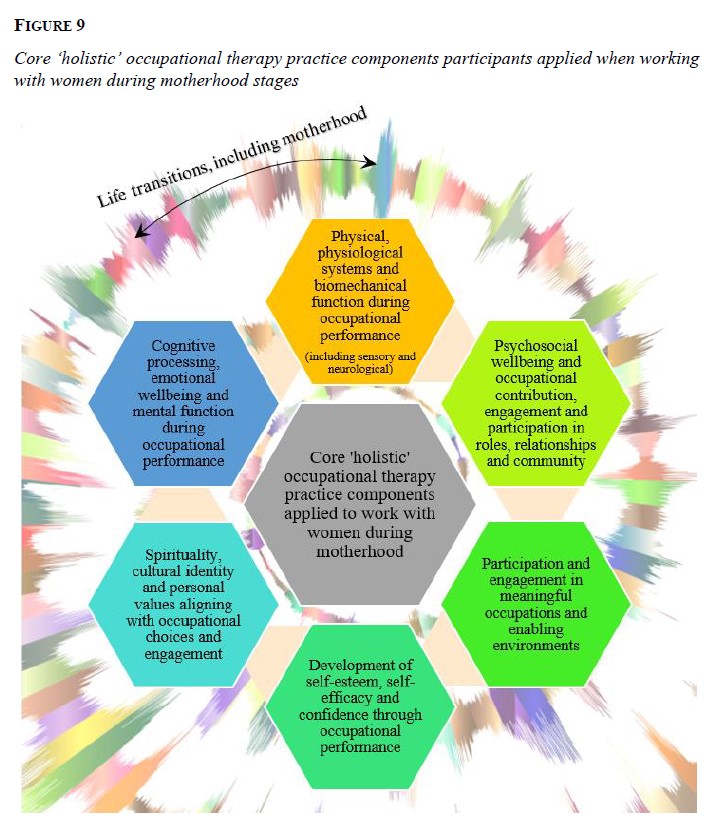
Reprinted Figure 9, taken from page 201 of Slootjes, H. (2022). The Role of Occupational Therapists in Perinatal Health [Doctoral thesis, La Trobe University]. Open Access at La Trobe (OPAL). https://doi.org/10.26181/19836172.v1Click here to access via OPAL.

Did you know that occupational therapists have been practicing in perinatal health for decades? Many of the core skills OTs can be applied to support women’s occupational performance issues and needs during perinatal stages and matrescence, which a growing number of passionate OTs around the world are discovering. This emerging non-traditional practice area has long been shrouded in ambiguity, with questions about professional integrity, role scope, and lack of clarity about OTs place in maternity care teams. After nine years, my PhD research has been published in an open-access thesis, titled, “The Role of Occupational Therapists in Perinatal Health“.

I’m passionate about OTs in perinatal health and matrescence, and am so keen to share my research with anyone who’s interested or as invested as I am. But unless you’re feeling well in lockdown with absolutely nothing else to think about or do, an 80,000 word thesis is way (waaayyy) too much to read through. So, over the next few weeks I’m going to share bite-sized chunks of my thesis to help share knowledge and promote reflective thinking, constructive debate, and professional development for OTs in perinatal health and matrescence.

Thank you to all of the OTs who practice in this space, and especially to those who shared their experiences with me for this PhD research. I’m looking so forward to continuing to make as much of a contribution as I can with my research, and am so excited to see OT roles in women’s health, perinatal health, and matrescence bloom! Sleeves are rolled up, and here we go…

Research boom! Skates on in the exciting occupational therapy in perinatal health race

My PhD pre-submission milestone is checked off (hoorah!), and I’m in the final stages of finishing up my thesis for submission. What a journey this is! In wrapping things up, I’ve run another sweep of other research theses which have been published recently about the role of occupational therapy in perinatal health. What a complete surprise… the research output cogs are S P I N N I N G!!! So exciting! I’ve updated my ‘resources page‘ to list all of the graduate research student theses found so far, and will continue updating it as they pop up.

Am I feeling the pressure to publish my thesis? Yes! Absolutely. I wish I had a magical remote control to speed up the process, but perhaps there is something extra in a process taking this long. Ideas have marinated, and I’ve had so much opportunity to listen to participant’s voices in the greatest depth. My research is (thankfully!) still unique, and I can’t wait to contribute my findings and perspective to this exciting new knowledge wave.

“A word after a word after a word is power”

Margaret Atwood

I’m feeling incredibly excited that the spotlight is on how occupational therapists can support women during perinatal stages. Keep it up, squad! The movement is well and truly underway. The more voices joining in the choir, the more powerful the sound…

Learn to unite with other women.

United women can produce more,

Unlike divided women who cannot build anything together.

Gift Gugu Mona