New publication! Practitioner perspectives of OTs role in perinatal health (OPAL)

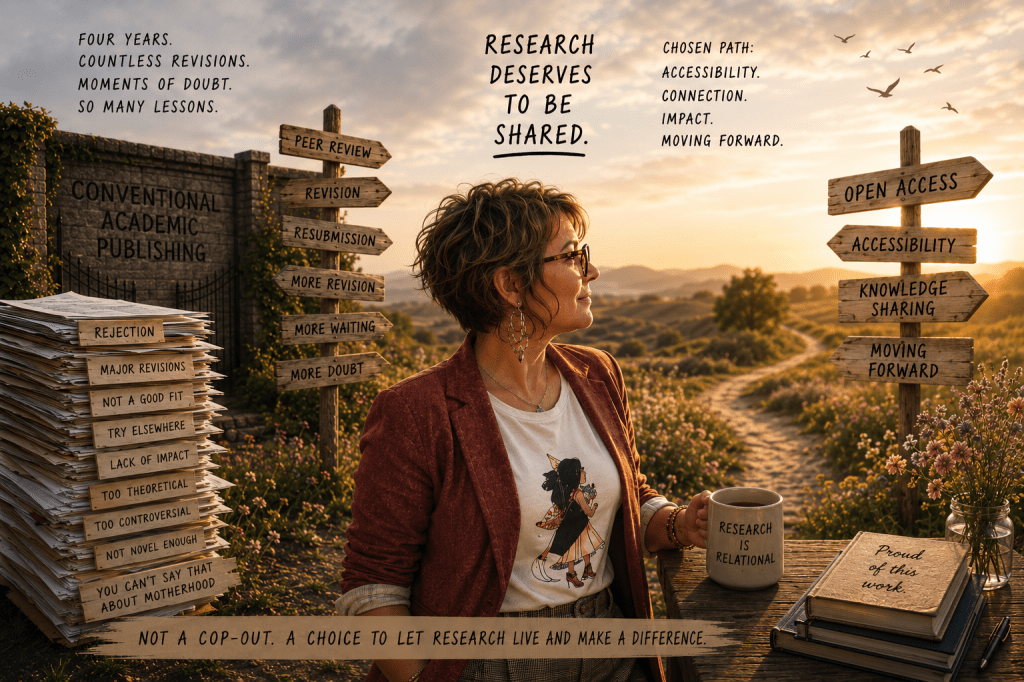
Image created by author 15/05/2026 using ChatGPT (generative AI)

It’s a watershed moment… After four years of trying to publish a core manuscript from my PhD research through traditional academic channels, I’m proud to celebrate that my supervision team and I have made the decision to share this paper openly through OPAL, La Trobe University’s open-access repository.

Slootjes, H., McKinstry, C., Hooker, L., & Kenny, A. (2026). Practitioner perspectives on the contemporary role of occupational therapists working with women during perinatal transitions: A multiple case study. [Report]. (Version 2). La Trobe. https://doi.org/10.26181/31977858

The report explores practitioner perspectives on the role of OT working with women during perinatal transitions, and draws on my doctoral research. This publication includes additional information that didn’t make it into my PhD thesis, for example:

  • Some lovely rich quotes from participants (pages 12-15)
  • The original thematic analysis framework (like a mindmap) on page 20
  • And a slightly different way of writing to help keep things a bit more readable.

To be honest, making this decision has not been easy. But we’ve made the right choice, and I’m so proud to be able to share this research freely for anyone who has access to the internet.

Why the worry? Does it really matter where the research is published?

Yeah, it does.

In academia, research like this is most respected and acknowledged when it is offered a place in a peer-reviewed journal. Over the past four years, the manuscript has gone through multiple rounds of peer review, revision, restructuring, and resubmission. Some feedback was so insightful and constructive, and strengthened the paper significantly. Some highlighted the difficulty of positioning non-traditional OT practice, feminist, and contentiously innovative concepts within conventional healthcare and knowledge structures. Some was downright brutal and made me question if there’s any point in trying or continuing any of this.

This is the nature of academia. There’s the full spectrum of perspectives out there, and we have to be determined, thoughtful, constructive, resilient, and flexible as we navigate peer-reviews. We trust that this rigorous filtration process will lead to the best possible research being accepted for publication, so we can confidently rely on scientific literature in reserach and practice.

Eventually, after 4-years of trying to publish this article in over 10 peer-reviewed journals, I reached a point where I needed to decide whether to continue holding this work in review cycles indefinitely, or make it accessible and move forward into other projects. Thankfully, my supervision team were supportive, and so here we are 🎊

I’ve chosen accessibility. And to prioritise my own mental health! I’ve got loads of other things I’m hanging to work on, and I’m ready to move on. Publishing this manuscript was a key milestone to enable this.

This paper reflects work I remain absolutely proud of. It emerges from years of research, listening, consultation, reflexivity, triangulated critical thinking, peer review, revision, and intellectual labour.

So, this is a celebration of publishing a research report. It has been rigorously shaped through critique and refinement over time. I am so proud of this work.

Even though it’s not nested within a peer-reviewed journal and subsequently won’t come up in many database searches for literature reviews, I hope – and trust – that it’s still useful for those who need it.

So, that’s that. Let’s celebrate this for what it is, and move on ✨

There’s so much to do… I wonder what to work on first?!
The next chapter begins, starting with a book

Well. It’s certainly been a long while since my last blog post! September 2022 was my last post – I’d just finished my PhD, we were still somewhere in the middle of the COVID-19 lockdowns, and, honestly, life was every kind of upside down there for a while.

Fast forward to now.

I’d like to say that I’ve taken a proper break, rested my brain, and enjoyed the quiet after years of thinking so intensely. But… life didn’t quite work out that way. When does it ever?! Anyway. We’re here now, and things are still on the go.

It’s no secret that in the last few years of writing my thesis I’d been brewing up a textbook. I know I’m not the only OT in this space who’s felt this way! My mind was so full of information and ideas that I hadn’t been able to fit into the PhD thesis, and I felt a huge pressure of carrying all of this. It was actually exhausting! I kept joking with anyone who’d listen that I felt “like a walking library”, and then thinking to myself, “what’s the use of all of this information sitting in my head?!”. It was a lot.

So, I just had to write a textbook.

Once the decision was made, it all happened pretty quickly. The proposal I pitched to a publisher was accepted (amazing, I know!), so then I just had to make it happen. I took two years off work and started my own microbusiness, pared everything back to make life as simple as possible, and let my amazing family, friends, and community help and support me with the kids – with the hand-on-heart agreement that I would take a proper break after this one.

I’d rolled my sleeves up and was getting stuck into the writing, and then a kind and brilliant colleague in the US (Apple, thank you!) reminded me that I didn’t know everything and couldn’t write such an important book on my own – which, of course, was entirely true! So I reached out to the global OT community to see if anyone wanted to contribute, and the response was overwhelming. I set up 15-minute self-booked interviews for people so we could meet and chat about ideas, and talked to over 150 OTs and academics from all over the world about contributions for this book.

My mind was blown. I realised how overdue and needed this book was for our profession, which created an overwhelming sense of responsibility.

So I went back to the drawing board a bit and changed the original textbook pitch to better suit the global community of OTs who had and were already invested in it. Thankfully, the publisher was 100% on board, and we successfully applied to double the original wordcount, and I became an editor as well as author.

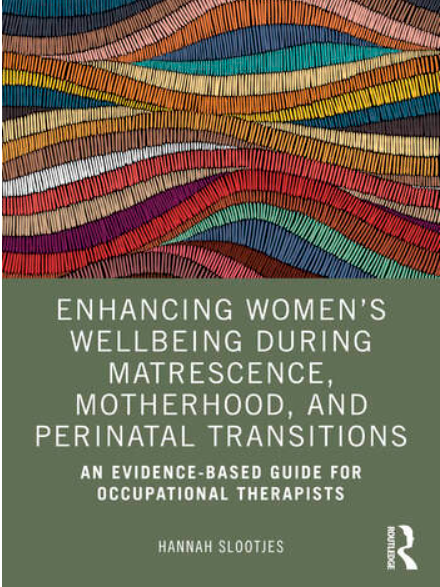
Slootjes, H. (Ed.). (2025). Enhancing women’s wellbeing during matrescence, motherhood, and perinatal transitions: An evidence-based guide for occupational therapists (1st ed.). Routledge. https://www.routledge.com/9781032502793

The textbook now has 24 chapters in three sections, with 65 contributors from Australia, Brazil, Canada, the Netherlands, New Zealand, South Africa, UK, and USA. We almost had contributions from India and First Nations Women, but it wasn’t meant to be. I’m hoping things will evolve for the 2nd edition – as well as so much more. There’s certainly a lot to cover, and hopefully this is a good enough start.

If you’d like to have a look at the textbook, it’s listed on the Taylor & Francis/Routledge website, including:

  • Textbook overview
  • Table of contents, and contributors (we’ll acknowledge these individuals in posts as we go on from here)
  • Critics reviews (heads up… they’re incredible!)

So now, we’re nearly at publication o’clock. Writing this textbook has been an incredible privilege. It’s been a huge project, and truly humbling. Like the PhD, it’s impossible to fit everything you want to say into one text. There were stories, reflections, insights, and knowledge branches we had to let go of. So, I’m coming back to this blog to share in a space to unpack those, to sit with ideas a little longer, to write without word limits or publishing deadlines.

I’m looking forward to using this space again to share my learning and reflections, and building it into my weekly routine again. So, here we go with the next chapter, starting with the book…