

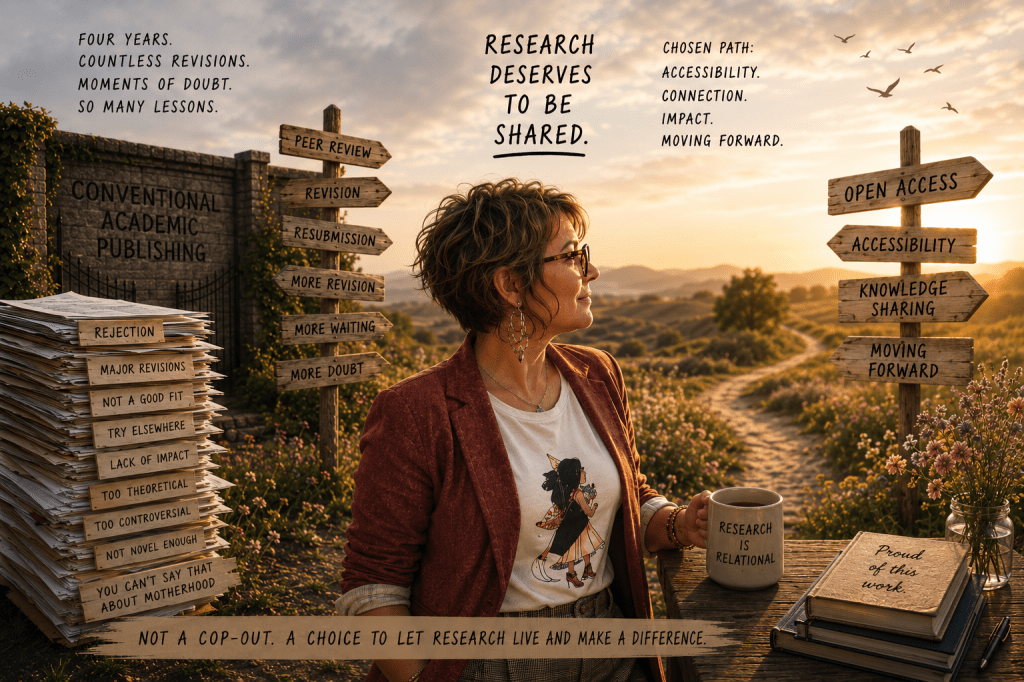
It’s a watershed moment… After four years of trying to publish a core manuscript from my PhD research through traditional academic channels, I’m proud to celebrate that my supervision team and I have made the decision to share this paper openly through OPAL, La Trobe University’s open-access repository.
Slootjes, H., McKinstry, C., Hooker, L., & Kenny, A. (2026). Practitioner perspectives on the contemporary role of occupational therapists working with women during perinatal transitions: A multiple case study. [Report]. (Version 2). La Trobe. https://doi.org/10.26181/31977858
The report explores practitioner perspectives on the role of OT working with women during perinatal transitions, and draws on my doctoral research. This publication includes additional information that didn’t make it into my PhD thesis, for example:
- Some lovely rich quotes from participants (pages 12-15)
- The original thematic analysis framework (like a mindmap) on page 20
- And a slightly different way of writing to help keep things a bit more readable.
To be honest, making this decision has not been easy. But we’ve made the right choice, and I’m so proud to be able to share this research freely for anyone who has access to the internet.
Why the worry? Does it really matter where the research is published?
Yeah, it does.
In academia, research like this is most respected and acknowledged when it is offered a place in a peer-reviewed journal. Over the past four years, the manuscript has gone through multiple rounds of peer review, revision, restructuring, and resubmission. Some feedback was so insightful and constructive, and strengthened the paper significantly. Some highlighted the difficulty of positioning non-traditional OT practice, feminist, and contentiously innovative concepts within conventional healthcare and knowledge structures. Some was downright brutal and made me question if there’s any point in trying or continuing any of this.
This is the nature of academia. There’s the full spectrum of perspectives out there, and we have to be determined, thoughtful, constructive, resilient, and flexible as we navigate peer-reviews. We trust that this rigorous filtration process will lead to the best possible research being accepted for publication, so we can confidently rely on scientific literature in reserach and practice.
Eventually, after 4-years of trying to publish this article in over 10 peer-reviewed journals, I reached a point where I needed to decide whether to continue holding this work in review cycles indefinitely, or make it accessible and move forward into other projects. Thankfully, my supervision team were supportive, and so here we are 🎊
I’ve chosen accessibility. And to prioritise my own mental health! I’ve got loads of other things I’m hanging to work on, and I’m ready to move on. Publishing this manuscript was a key milestone to enable this.
This paper reflects work I remain absolutely proud of. It emerges from years of research, listening, consultation, reflexivity, triangulated critical thinking, peer review, revision, and intellectual labour.
So, this is a celebration of publishing a research report. It has been rigorously shaped through critique and refinement over time. I am so proud of this work.
Even though it’s not nested within a peer-reviewed journal and subsequently won’t come up in many database searches for literature reviews, I hope – and trust – that it’s still useful for those who need it.
So, that’s that. Let’s celebrate this for what it is, and move on ✨
There’s so much to do… I wonder what to work on first?!


